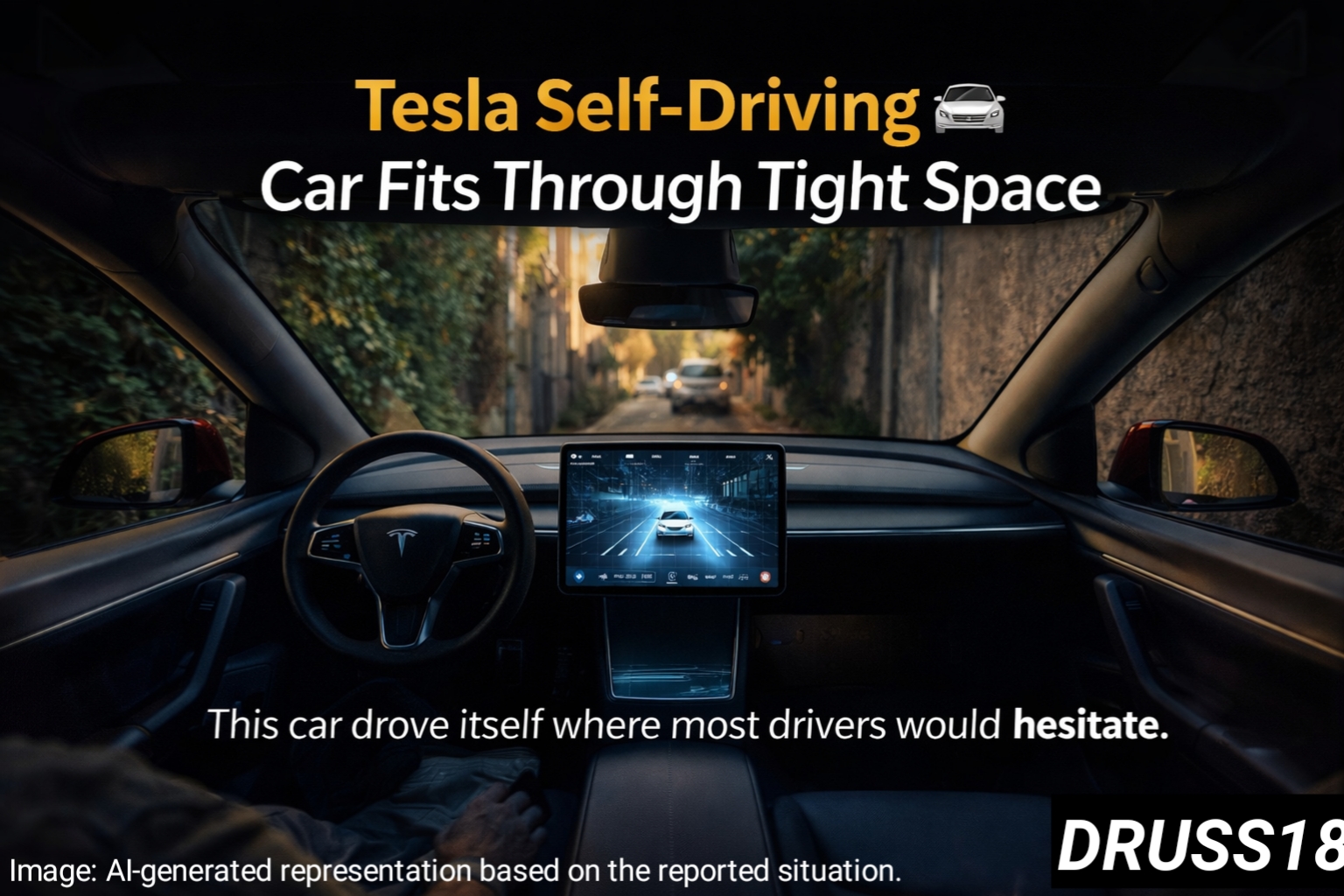
A Tesla self-driving car is seen navigating an extremely tight space in a viral clip.
The moment looks simple—but highlights a complex challenge in autonomous driving.
It offers a glimpse into how close real-world AI driving may be.
A Simple Clip That Raises a Bigger Question
Can a car really handle tight, unpredictable roads on its own?
A viral video shared by Tesla shows a vehicle carefully moving through a narrow space, appearing to “squeeze through” without human intervention.
At first glance, it looks like a routine maneuver. But something feels different. Most human drivers would slow down, hesitate, or even stop in such a situation. Here, the system continues smoothly—suggesting a level of spatial awareness that is still evolving in autonomous driving.
This contrast between expectation and reality is what makes the clip stand out.
How the System Interprets the Road
Tesla’s approach to autonomy relies heavily on vision-based AI.
According to Tesla, its system uses cameras and neural networks to understand the environment in real time. Instead of depending only on pre-mapped routes, the vehicle processes what it “sees” moment by moment.
Data from NASA and broader AI research highlights how difficult real-time decision-making can be in dynamic environments. Small variations—like road width, lighting, or unexpected obstacles—can significantly affect outcomes.
That is why navigating tight urban spaces remains a meaningful test for any self-driving system.
Why Tight Spaces Are a Real Challenge
Driving through narrow roads is not just about steering accuracy.
It requires constant micro-adjustments, awareness of surrounding objects, and prediction of potential movement. For humans, this often involves instinct and experience. For machines, it depends on data and training.
As reported by Reuters, autonomous driving systems have made rapid progress, but edge cases—rare or complex scenarios—still present challenges.
What It Means for Everyday Driving
If such capabilities become reliable, they could reshape daily transportation.
Drivers could experience less stress in crowded cities. Parking, narrow lanes, and complex turns may become easier to handle with AI assistance.
For some, this technology could improve accessibility—especially for older adults or people with limited mobility.
At the same time, current systems are not fully autonomous in all situations. Human supervision is still required, and regulations vary across regions.
This balance between progress and limitation defines where the technology stands today.
A Glimpse Into the Future of Mobility
The development of self-driving systems is closely linked to advances in artificial intelligence.
What begins in cars could expand into logistics, robotics, and smart infrastructure. The ability for machines to interpret real-world environments has implications far beyond transportation.
One surprising shift is how quickly these systems are improving. Scenarios that once seemed difficult are gradually becoming manageable—though not yet perfect.
This suggests that autonomous driving is not a distant concept, but an evolving reality.
Conclusion
What we know: the system successfully navigated a tight and complex driving scenario.
What’s uncertain: how consistently such performance can be achieved across all real-world conditions.
What’s next: continued development, more real-world testing, and gradual expansion of capabilities.
As self-driving technology advances, moments like this may become routine—but for now, they offer a clear glimpse into what lies ahead.
👉 The real question is—how much control are we ready to hand over to machines?
- This article is based on publicly available data, official updates, and verified reports from Tesla, NASA, and other trusted scientific sources.