- Category: Science / Space
- Author: Druss18 Team
- Date: March 29, 2026
Summary:
- The arrival of the Artemis II crew at NASA’s launch site signals a major milestone in humanity’s return to the Moon. The mission will test deep-space systems with astronauts aboard for the first time since 1972.
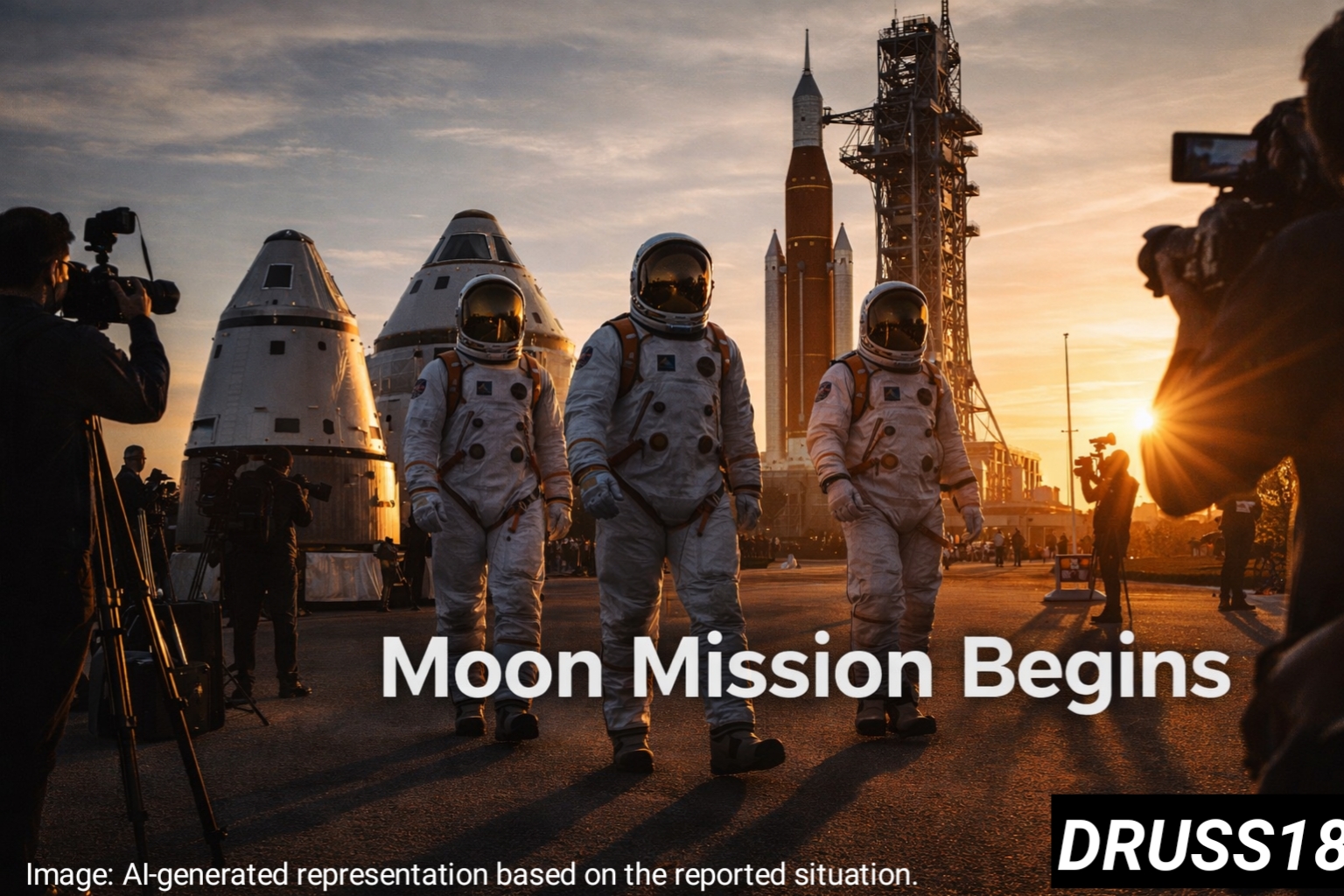
As the Artemis II crew arrival unfolds at Kennedy Space Center, it marks more than a routine pre-launch event. It represents a pivotal moment in NASA’s long-term effort to return humans to the Moon—this time with the goal of staying.
The Artemis II mission, part of NASA’s broader Artemis program, will be the first crewed flight of the Orion spacecraft beyond low Earth orbit. Scheduled as a lunar flyby mission, it aims to validate life-support systems, navigation, and deep-space operations with astronauts onboard for the first time in over five decades.
A Mission Built on Artemis I
The foundation for Artemis II was laid during the uncrewed Artemis I mission in 2022. According to NASA’s official mission data, Orion traveled more than 1.4 million miles during that test flight, demonstrating its ability to operate safely in deep space.
Now, with astronauts preparing for launch, NASA is shifting from system validation to human exploration.
According to NASA’s Artemis campaign documentation, Artemis II will carry four astronauts on a trajectory around the Moon, reaching distances of approximately 460,000 kilometers from Earth. This places the mission farther than any human has traveled since the Apollo era.
Why the Crew Arrival Matters
Crew arrival at Kennedy Space Center is not just ceremonial—it signals the beginning of final integrated operations.
Astronauts will undergo:
Final spacecraft checks
Launch simulations
Coordination with ground control teams
As outlined in NASA’s pre-launch protocols, this phase ensures that both crew and mission systems are fully synchronized before liftoff.
The Orion spacecraft, built by Lockheed Martin, has been specifically designed for long-duration deep-space missions. Meanwhile, the Space Launch System (SLS), NASA’s most powerful rocket, will carry Orion into orbit before sending it toward the Moon.
A Global Effort Beyond NASA
While NASA leads the Artemis program, it is far from a solo effort.
The European Space Agency has contributed the Orion service module, which provides propulsion, power, and thermal control. According to ESA technical briefings, this module is critical for sustaining astronauts during the multi-day lunar journey.
In addition, international partnerships under the Artemis Accords are shaping future lunar exploration, including planned surface missions and long-term habitation strategies.
The Bigger Picture: Why Artemis II Matters
The significance of the Artemis II crew arrival goes beyond a single mission.
NASA’s long-term roadmap includes:
Artemis III: A crewed lunar landing
Lunar Gateway: A space station orbiting the Moon
Sustainable human presence on the lunar surface
According to NASA’s exploration strategy, Artemis missions are also designed to serve as stepping stones for future human missions to Mars.
The technologies being tested—life support, radiation protection, and deep-space navigation—are directly applicable to long-duration interplanetary travel.
What Comes Next
Following Artemis II, NASA plans to move quickly toward landing astronauts on the Moon’s south pole, a region believed to contain water ice deposits. Data from NASA’s Lunar Reconnaissance Orbiter suggests these resources could support future human settlements.
However, challenges remain.
Mission timelines, budget constraints, and technical risks continue to shape the pace of Artemis development. The U.S. Government Accountability Office (GAO) has previously noted schedule pressures within the program, highlighting the complexity of coordinating multiple systems and partners.
Still, momentum is building.
The arrival of the Artemis II crew is a visible reminder that human deep-space exploration is no longer theoretical—it is actively underway.
A New Chapter in Human Spaceflight
For many, Artemis II evokes echoes of the Apollo missions. But this time, the objective is different.
Instead of brief visits, NASA is aiming for sustained exploration—turning the Moon into a proving ground for future missions beyond.
As the crew prepares for launch, one question quietly emerges:
If Artemis II succeeds, how quickly will humanity push further into the solar system?
The answer may define the next era of space exploration.
Sources & Credits:
NASA – Artemis Program Overview and Mission Updates
NASA – Artemis I Mission Data and Orion Flight Results
European Space Agency (ESA) – Orion Service Module Technical Briefing
Lockheed Martin – Orion Spacecraft Development Information
U.S. Government Accountability Office (GAO) – NASA Artemis Program Reports