- Category: Science / Space
- Author: Druss18 Team
- Date: March 31, 2026
Summary:
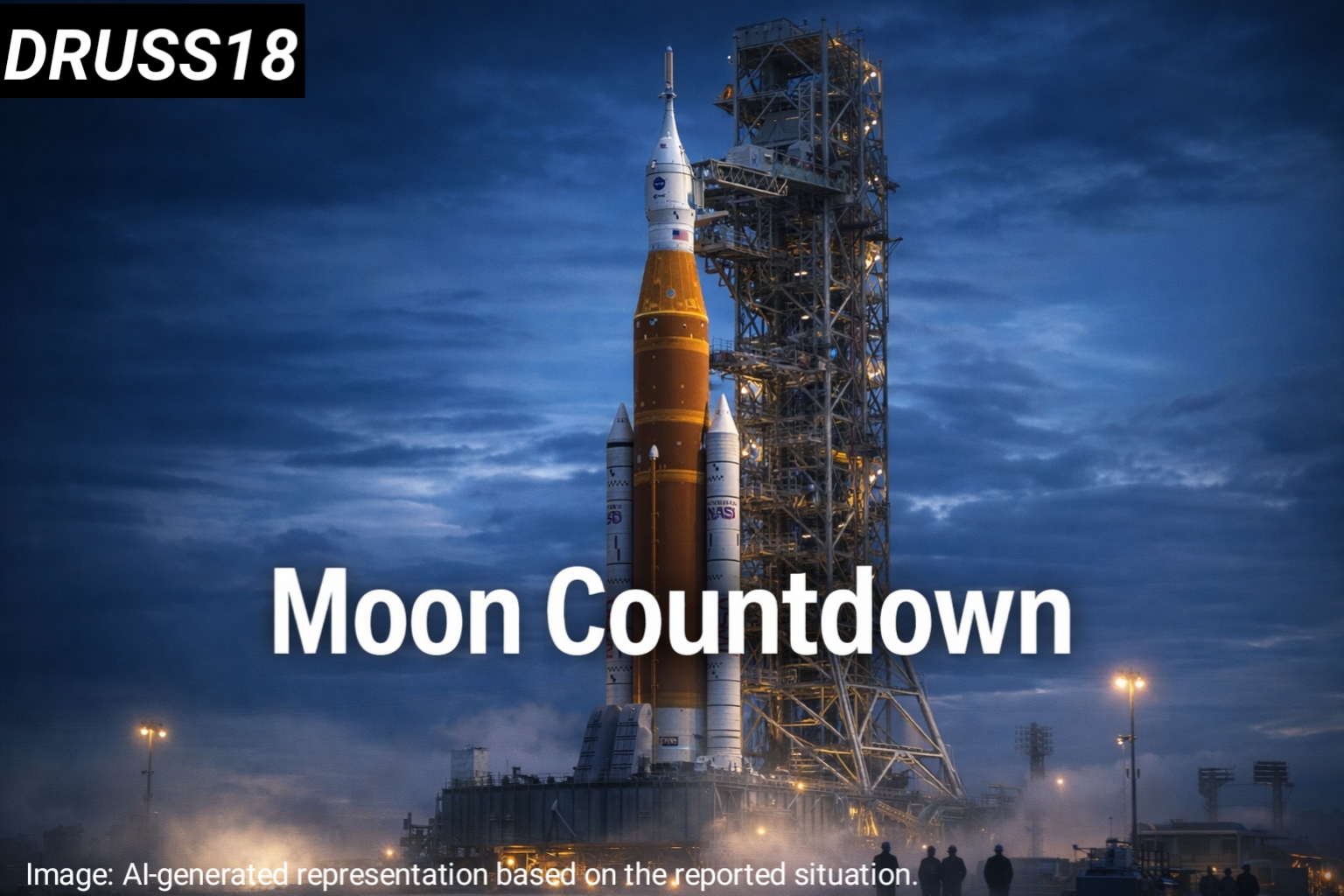
NASA has entered the final countdown phase for its Artemis II mission, with teams positioned at the Kennedy Space Center. The crewed lunar flyby is expected within 48 hours, marking a critical step toward returning humans to the Moon.
The Final Countdown for Artemis II Has Begun
The Artemis II countdown is now officially underway, as NASA prepares for one of its most significant human spaceflight missions in decades. Teams have taken their positions inside the Launch Control Center at
Kennedy Space Center, signaling that operations have entered a tightly coordinated final phase.
According to NASA’s latest mission update, the agency is approximately 48 hours away from launch, provided weather conditions and system checks remain within acceptable limits.
This mission represents the first time since the
Apollo program that astronauts will travel beyond low Earth orbit toward the Moon.
What Artemis II Will Do
The Artemis II mission is designed as a crewed lunar flyby rather than a landing. Astronauts aboard the
Orion spacecraft will travel thousands of kilometers beyond the Moon before returning to Earth.
The spacecraft will be launched using NASA’s heavy-lift rocket, the
Space Launch System, which NASA describes as the most powerful rocket currently in operation.
According to official NASA mission documentation, the primary goals include:
Testing life-support systems in deep space
Validating navigation and communication beyond Earth orbit
Demonstrating safe re-entry at lunar-return velocities
The mission will not land on the Moon, but it is a critical precursor to future lunar surface missions.
Why This Mission Matters Now
The Artemis II countdown is more than just a launch sequence—it is part of a broader strategy to establish a sustained human presence beyond Earth.
NASA has outlined that Artemis II will directly support upcoming missions, including Artemis III, which aims to land astronauts near the lunar south pole. The agency has emphasized that data collected during Artemis II will inform both engineering decisions and crew safety protocols.
In parallel, the
European Space Agency has contributed key service module components for the Orion spacecraft, highlighting the mission’s international collaboration.
Engineering Precision and Risk Management
Space missions operate within narrow margins, and Artemis II is no exception. Engineers are conducting continuous system checks, including propulsion, avionics, and thermal protection systems.
According to NASA’s technical briefings, multiple redundancy layers have been built into the spacecraft to handle potential anomalies during the mission. Additionally, launch conditions are being closely monitored by ground teams, with weather remaining a key variable.
The U.S.
Federal Aviation Administration also plays a regulatory role in overseeing launch safety, ensuring compliance with national standards.
A Step Toward Long-Duration Exploration
While Artemis II is a short-duration mission, its implications extend far beyond a single flight. NASA has consistently stated that the Artemis program is designed to support long-term goals, including potential crewed missions to Mars.
As outlined in NASA’s exploration roadmap, lunar missions serve as a testing ground for technologies such as deep-space habitats, radiation protection systems, and sustainable life-support infrastructure.
The mission also reflects a shift in how space exploration is conducted—moving from isolated missions toward integrated, long-term strategies involving multiple international and commercial partners.
Looking Ahead
The next 48 hours will determine whether Artemis II proceeds as planned or faces delays—a common reality in spaceflight. Regardless of timing, the mission marks a decisive moment in the evolution of human space exploration.
If successful, Artemis II will not only validate critical systems but also reaffirm the feasibility of sending humans deeper into space on a routine basis. The results will shape mission planning for years to come, influencing both lunar and interplanetary ambitions.
Sources & Credits:
NASA – Artemis II mission updates and technical briefings
European Space Agency – Orion service module contribution
Federal Aviation Administration – Launch safety regulations
Lockheed Martin – Orion spacecraft development