- Category: Science / Space
- Author: Druss18 Team
- Date: April 4, 2026
Summary:
NASA’s Artemis II Moon mission has entered a critical phase as astronauts travel farther from Earth, now closer to the Moon. The milestone highlights progress in deep-space human exploration and future lunar ambitions.
A Defining Moment in the Artemis II Moon Mission
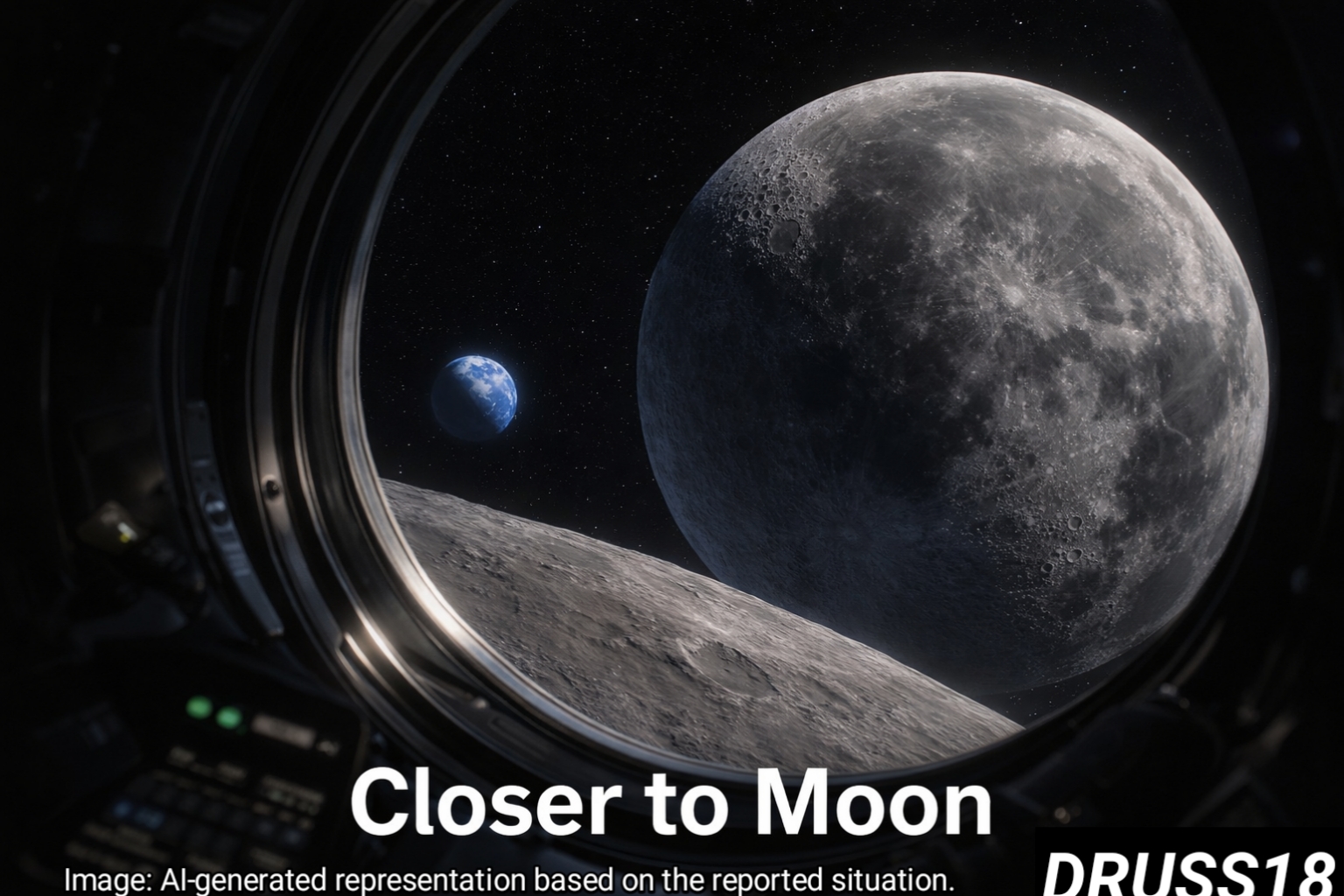
For the first time in decades, humans aboard a spacecraft are witnessing Earth shrink behind them while the Moon grows larger ahead. During Flight Day 3 of the Artemis II Moon mission, the crew confirmed a key milestone: they are now physically closer to the Moon than to Earth.
According to NASA, astronauts onboard the Orion spacecraft described seeing the Moon through the docking hatch—a rare and powerful visual moment that underscores how far the mission has progressed. The agency shared this update publicly, marking a symbolic and operational turning point in the journey.
This phase follows the spacecraft’s successful translunar injection, a maneuver that placed Orion on a precise trajectory toward lunar orbit. As outlined in NASA’s mission updates, this burn is one of the most critical steps in any Moon-bound mission.
What Makes This Phase So Important?
The Artemis II Moon mission is not just another spaceflight—it is a test of systems that will eventually carry humans back to the lunar surface. Unlike low Earth orbit missions, this journey pushes astronauts into deep space, where communication delays, radiation exposure, and navigation challenges become significantly more complex.
According to Lockheed Martin, the Orion spacecraft is designed to withstand these extreme conditions, including high-speed reentry temperatures exceeding 2,700°C. The company, which built Orion, has emphasized the spacecraft’s advanced life-support and navigation systems as key to mission safety.
Meanwhile, trajectory tracking and mission control operations are being closely monitored by NASA’s Deep Space Network, which ensures constant communication across millions of kilometers. This infrastructure plays a vital role in guiding the spacecraft as it moves deeper into space.
A Step Toward Long-Term Lunar Exploration
The Artemis II Moon mission builds directly on the success of Artemis I, an uncrewed test flight that validated Orion’s performance in lunar orbit. Now, with astronauts onboard, NASA is testing human endurance, onboard systems, and real-time mission operations.
According to the European Space Agency, which contributed the European Service Module powering Orion, international collaboration is central to the Artemis program. The module provides propulsion, power, and thermal control—essential systems for long-duration missions.
This mission also sets the stage for Artemis III, which aims to land astronauts on the Moon’s surface later this decade. Data collected during Artemis II will directly influence landing strategies, crew safety protocols, and future mission timelines.
Seeing Earth From Afar
As the spacecraft moves farther from Earth, astronauts are experiencing a perspective few humans have ever had. Earth appears as a distant blue sphere, while the Moon becomes a dominant presence in the spacecraft’s view.
Moments like these are not just visually striking—they carry scientific and psychological importance. Studies published in journals like Nature Human Behaviour have shown that viewing Earth from space can alter cognitive perception and emotional awareness, a phenomenon often referred to as the “overview effect.”
What Comes Next?
The Artemis II Moon mission will continue its trajectory around the Moon before beginning its return journey to Earth. Engineers will closely analyze system performance, communication stability, and crew health throughout the mission.
While this flight does not include a lunar landing, its success is essential for future missions that will. Questions remain about long-term sustainability, radiation risks, and the logistics of maintaining a human presence beyond Earth orbit.
Yet, with each milestone, NASA and its partners are steadily building the foundation for a new era of space exploration—one that extends beyond the Moon and potentially toward Mars.
Sources & Credits:
NASA – Artemis II Mission Updates
Lockheed Martin – Orion Spacecraft Technical Briefings
European Space Agency (ESA) – European Service Module Overview
Nature Human Behaviour – Research on “Overview Effect”