- Category: Science / Space
- Author: Druss18 Team
- Date: April 5, 2026
Summary:
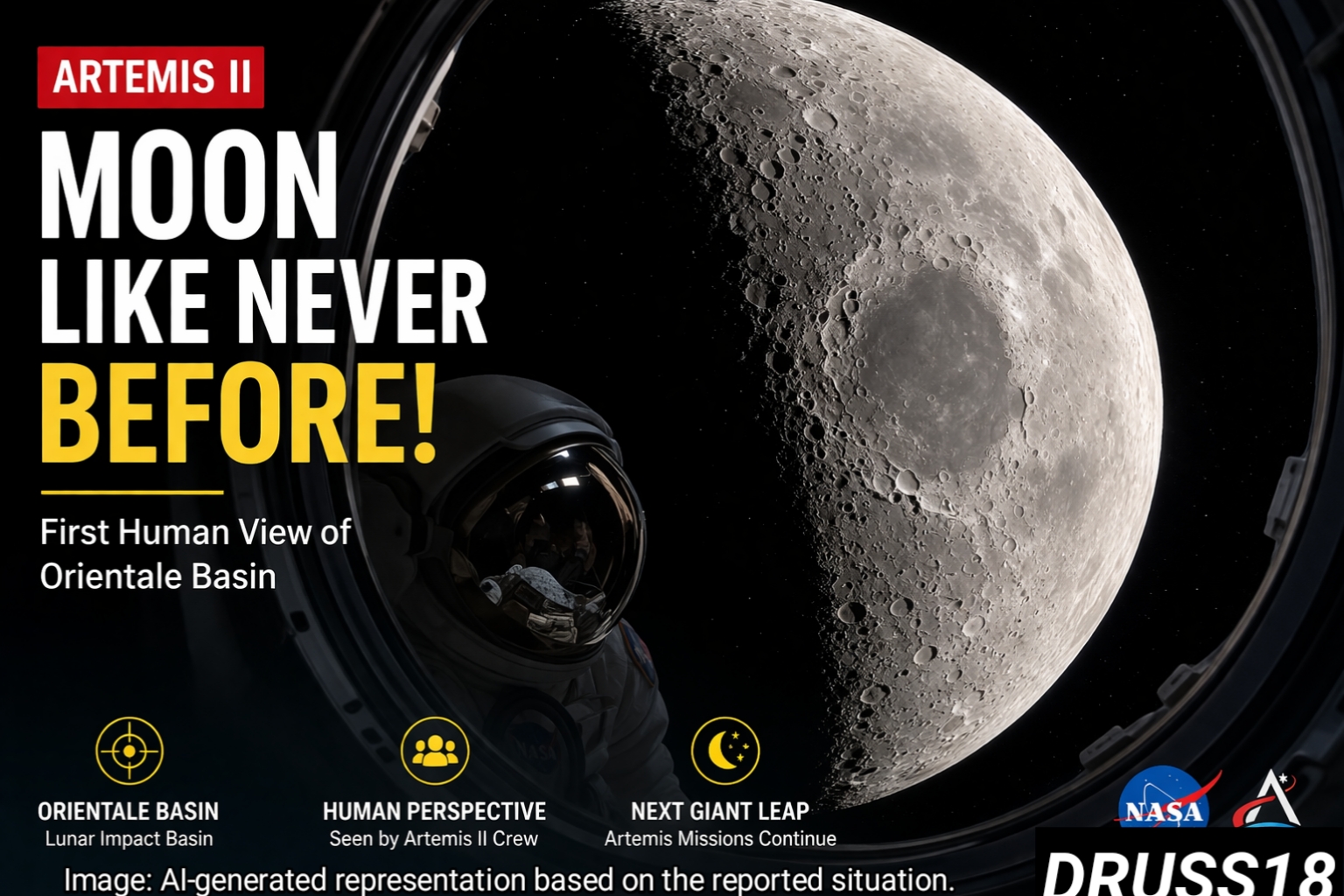
Artemis II Orientale Basin view A newly released image from NASA’s Artemis II mission shows the Moon’s Orientale Basin in a way never before seen by human eyes. The observation marks a subtle but significant milestone in humanity’s return to deep space exploration.
A rare human perspective on the Moon
For decades, the far edges of the Moon have been mapped, scanned, and photographed by robotic spacecraft. But now, with the Artemis II mission, a new image is offering something different—a direct human perspective.
The Artemis II Orientale Basin view has captured attention after NASA shared an image revealing the massive lunar impact basin along the Moon’s edge. According to NASA, this marks the first time the entire Orientale Basin has been visible to human observers in this way.
Unlike satellite imagery, which often stitches together data from multiple passes, this view reflects what astronauts can actually see with their own eyes. It’s a subtle distinction, but one that matters in human spaceflight.
What is the Orientale Basin?
The Orientale Basin is one of the Moon’s most prominent geological features. Located near the western limb of the Moon, it was formed billions of years ago by a massive asteroid impact.
Data from NASA’s Lunar Reconnaissance Orbiter (LRO) has previously mapped the basin in high resolution. However, as outlined in NASA’s mission updates, these were always remote observations.
The Artemis II image changes that context. It places human vision back into lunar exploration—something not seen since the era of Apollo program in the 1960s and 70s.
Why this Artemis II view matters
At first glance, a new Moon image may not seem significant. After all, thousands of lunar photos already exist. But the importance of this Artemis II Orientale Basin view lies in perspective, not resolution.
According to NASA, Artemis II is the first crewed mission designed to take astronauts beyond low Earth orbit since Apollo. That alone reintroduces a human observational layer that robotic missions cannot replicate.
Meanwhile, Lockheed Martin, which built the Orion spacecraft, has emphasized the role of crewed missions in validating systems for future lunar landings. Seeing features like the Orientale Basin directly helps contextualize navigation, visibility, and mission planning.
There is also a psychological dimension. Human observation—how astronauts perceive distance, scale, and terrain—plays a critical role in preparing for eventual surface missions.
From Apollo to Artemis: a shift in exploration
The Apollo missions provided humanity’s first close look at the Moon. However, their trajectories did not offer the same viewing geometry for features like the Orientale Basin.
Today, Artemis II follows a different flight path. As described in NASA’s Artemis mission framework, the mission is designed to test deep-space travel systems while orbiting the Moon before future landings.
The European contribution is also significant. The Orion spacecraft’s service module, developed by European Space Agency, supports propulsion and life support systems essential for extended missions.
This international collaboration reflects a broader shift in how space exploration is conducted—less about singular achievements, more about sustained presence.
Looking ahead to future missions
The Artemis II mission is not intended to land on the Moon. Instead, it serves as a precursor to Artemis III, which aims to return humans to the lunar surface.
Still, moments like the Artemis II Orientale Basin view hint at what lies ahead. They remind us that exploration is not only about collecting data, but also about expanding human experience.
As NASA outlines in its Artemis roadmap, future missions will focus on long-term lunar presence, infrastructure development, and eventually, preparation for Mars exploration.
But before any of that happens, astronauts must first see, navigate, and understand the environment around them.
And sometimes, that begins with simply looking out the window.
Sources & Credits:
NASA – Artemis II mission updates and lunar observations
European Space Agency – Orion service module details
Lockheed Martin – Orion spacecraft development insights
NASA Lunar Reconnaissance Orbiter (LRO) mission data