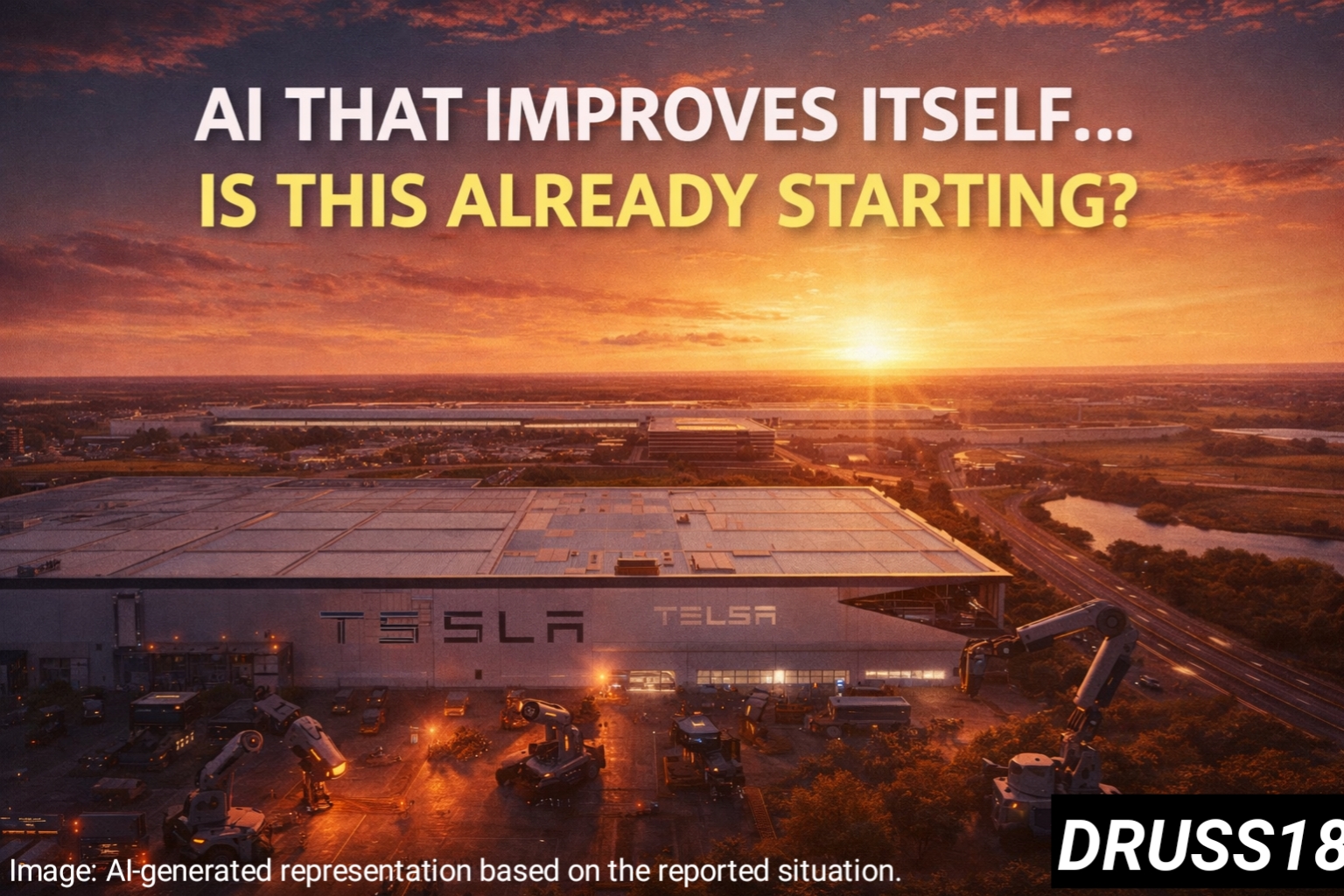
Elon Musk Signals Rapid AI Shift With New Texas Tech Facility
A short phrase from Elon Musk has reignited global debate around artificial intelligence. Behind it is a massive new technology facility in Texas. And the implications could reach far beyond manufacturing.
A Short Phrase, A Big Signal
When Elon Musk posted “rapid recursive improvement,” it seemed almost too brief to matter. Yet within hours, the phrase began circulating across scientific and tech communities.
The reason is simple: in AI research, “recursive improvement” refers to systems that can enhance themselves—potentially accelerating innovation at a pace humans struggle to match.
What made the moment more intriguing was the context. The statement appeared alongside references to an advanced manufacturing facility in Austin, Texas.
Expectation vs reality: what looked like a casual post may actually hint at a deeper industrial and technological shift already underway.
Inside the Advanced Technology Facility
Inside the Advanced Technology Facility
Images linked to the post suggest a large-scale production site associated with Tesla and possibly connected to broader infrastructure ambitions involving SpaceX.
According to public updates from Tesla, the company has been expanding its manufacturing capabilities in Texas, focusing on automation and energy systems. Meanwhile, SpaceX continues to push advancements in reusable rocket technology and large-scale engineering.
As reported by Reuters, Musk has increasingly emphasized vertically integrated systems—where hardware, software, and AI development converge in a single ecosystem.
If accurate, the “advanced technology fab” could represent a step toward highly automated production powered by AI-driven optimization.
What “Rapid Recursive Improvement” Really Means
In scientific terms, recursive improvement is not science fiction—but it remains largely theoretical at scale.
Data from NASA and ongoing AI research suggest that machine learning systems already improve through iterative training. However, fully autonomous self-improving systems—where AI redesigns its own architecture—are still under active study.
The concept raises both excitement and caution:
Faster technological breakthroughs
Reduced human intervention in design
Potential risks around control and safety
This is why researchers often connect it to long-term discussions about artificial general intelligence (AGI).
Why This Matters Beyond Tech Circles
This is not just about AI labs or Silicon Valley.
If recursive improvement becomes practical, it could reshape industries worldwide:
Manufacturing could become largely autonomous
Energy systems may scale more efficiently
Space exploration could accelerate
For everyday people, this may translate into cheaper products, faster innovation cycles, and entirely new job landscapes.
Viral Hook Line:
“What if machines didn’t just learn—but started improving themselves faster than we can understand?”
The Limits and Unknowns
Despite the excitement, significant challenges remain.
Experts caution that:
AI systems still depend heavily on human-designed frameworks
Scaling self-improvement safely is unresolved
Regulatory and ethical concerns are growing
Even Tesla’s advanced automation efforts rely on carefully controlled environments—not fully autonomous evolution.
What Comes Next
The combination of AI language and large-scale industrial infrastructure signals a broader direction.
Whether this is an early step toward self-improving systems or simply an evolution of automation remains unclear.
It is important to note that Elon Musk has not directly confirmed the purpose of the facility or explicitly linked it to advanced AI development. Current interpretations are based on publicly available information, and the full context behind the statement remains uncertain.
What is certain is that companies like SpaceX and Tesla are positioning themselves at the intersection of AI, energy, and manufacturing.
And that intersection could define the next phase of global technology.
Conclusion
We know that Elon Musk’s statement reflects real scientific ideas already being explored. We also know that large-scale infrastructure to support such ideas is expanding.
What remains uncertain is how quickly theory becomes reality—and how society adapts when it does.
The bigger question now is not whether change is coming, but how fast it will unfold.
Source Line:
This article is based on publicly available data, official updates, and verified reports from SpaceX, NASA, and other trusted scientific sources.