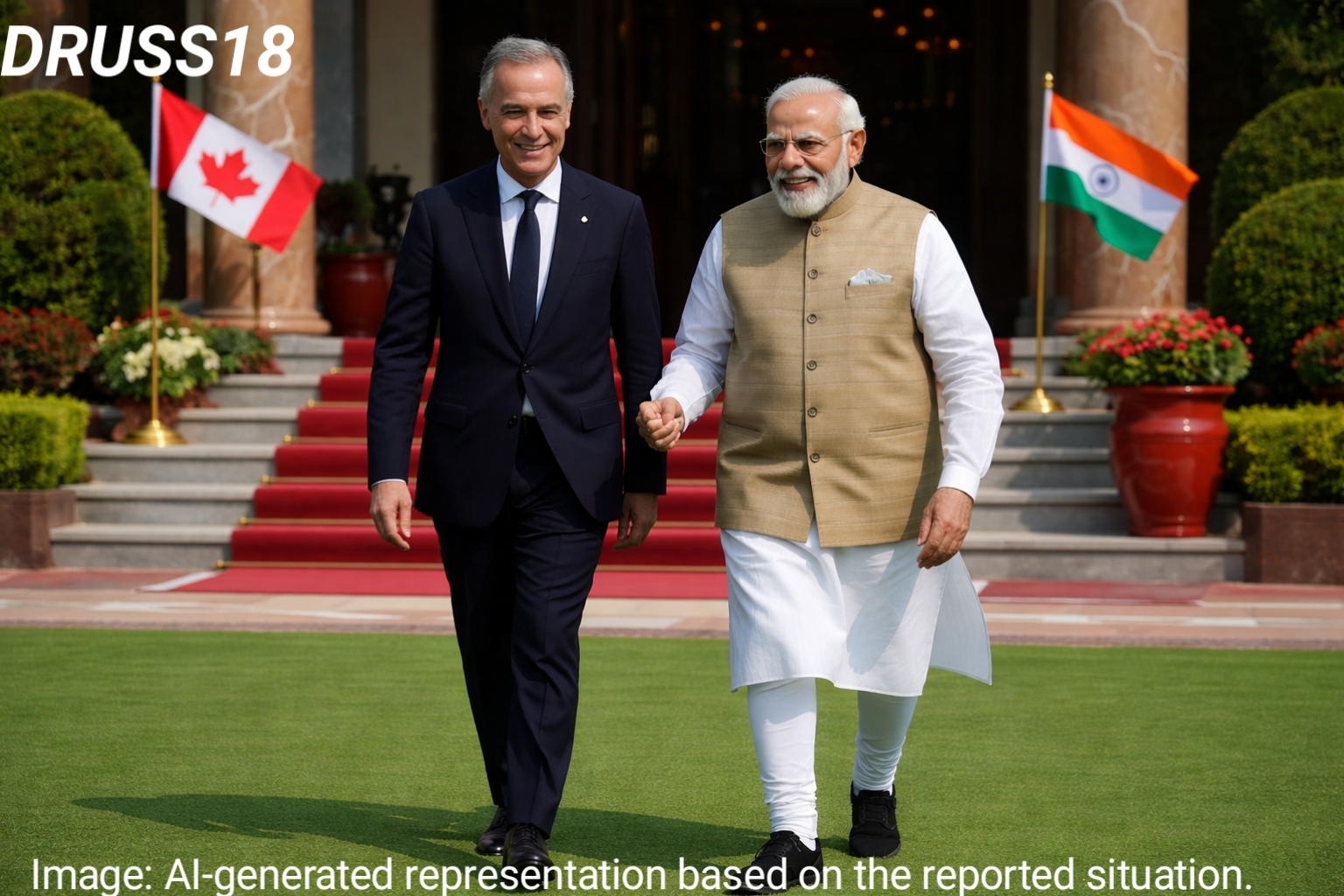
Business Focus Takes Center Stage as 2023 Killing Dispute Remains in Background
Mark Carney and Narendra Modi Move to Reset Canada-India Ties With Trade Push
Canada and India signaled a fresh attempt to stabilize relations after two years of diplomatic strain.
Prime Minister Mark Carney met Prime Minister Narendra Modi in New Delhi, focusing primarily on trade, energy, and technology cooperation.
There was no direct public reference to Canada’s earlier allegation linking Indian agents to the 2023 killing of Sikh leader Hardeep Singh Nijjar in British Columbia.
How Relations Reached a Breaking Point
Tensions escalated in 2023 when former Prime Minister Justin Trudeau said Canadian agencies were examining credible allegations of Indian involvement in Nijjar’s death.
India denied the accusation.
Both countries expelled diplomats, and official engagement slowed sharply.
Diplomatic Thaw Begins
Talks began improving after Carney and Modi met at the Group of 7 summit in Alberta last year.
Since then, both governments have resumed dialogue aimed at rebuilding cooperation.
Recent statements emphasized partnership expansion rather than past disputes.
Canadian officials briefly referenced concerns about “transnational repression,” without further detail.
Key Economic Agreements
A major uranium supply deal worth about 2.5 billion Canadian dollars ($1.8 billion) was announced.
Shipments are scheduled from 2027 to 2035, supporting India’s nuclear energy sector.
Additional preliminary agreements cover:
Technology collaboration
Education partnerships
Broader trade discussions
Canada aims to finalize a wider trade agreement by year’s end.
Officials estimate bilateral trade could reach $50 billion annually by 2030.
For comparison, Canada-U.S. trade stands near $900 billion per year.
Why it matters:
Canadian exporters may gain access to one of the world’s fastest-growing major economies.
Sectors such as clean energy, agriculture, and higher education could see expanded opportunities.
Diversifying trade reduces reliance on the U.S. market.
Broader Foreign Policy Shift
Canada has been adjusting its global strategy amid shifting trade dynamics and geopolitical uncertainty.
Earlier this year, Carney also engaged China diplomatically after years of tension.
Speaking at the World Economic Forum in Davos, Carney emphasized a pragmatic approach to international relations.
The India reset reflects that strategy: prioritize economic stability while legal matters continue separately.
Legal Proceedings and Community Concerns
Canada has one of the largest Indian diaspora populations in the world, including the largest Sikh community outside India.
Some community members welcome improved ties, while others worry accountability could be overshadowed by trade priorities.
Three Indian nationals have been charged in Nijjar’s killing.
Canadian courts are handling the case, and certain evidence may remain confidential for national security reasons.
India denies involvement and has long criticized Canada over Sikh separatist activism.
What Happens Next
Businesses in both countries will watch for progress on a full trade agreement.
The uranium deal’s implementation timeline will be closely monitored.
Court proceedings in Canada could still influence diplomatic stability.
For now, both governments appear focused on rebuilding cooperation step by step, with economic growth as the main driver.