- Category: Science / Space
- Author: Druss18 Team
- Date: March 29, 2026
Summary:
The successful third flight of NASA’s X-59 marks steady progress toward reducing the sonic boom of supersonic aircraft. The experimental jet is designed to reshape the future of commercial air travel by making supersonic flight quieter and more acceptable over land.
The NASA X-59 third flight has added new momentum to a decades-long effort to make supersonic travel viable again—this time without the disruptive sonic boom that once grounded the technology.
According to NASA, the experimental aircraft recently completed its third test flight near Armstrong Flight Research Center, flying for approximately one hour as engineers closely monitored its performance. The flight marks a crucial step in validating the aircraft’s systems and aerodynamic design under real-world conditions.
What Makes the X-59 Different?
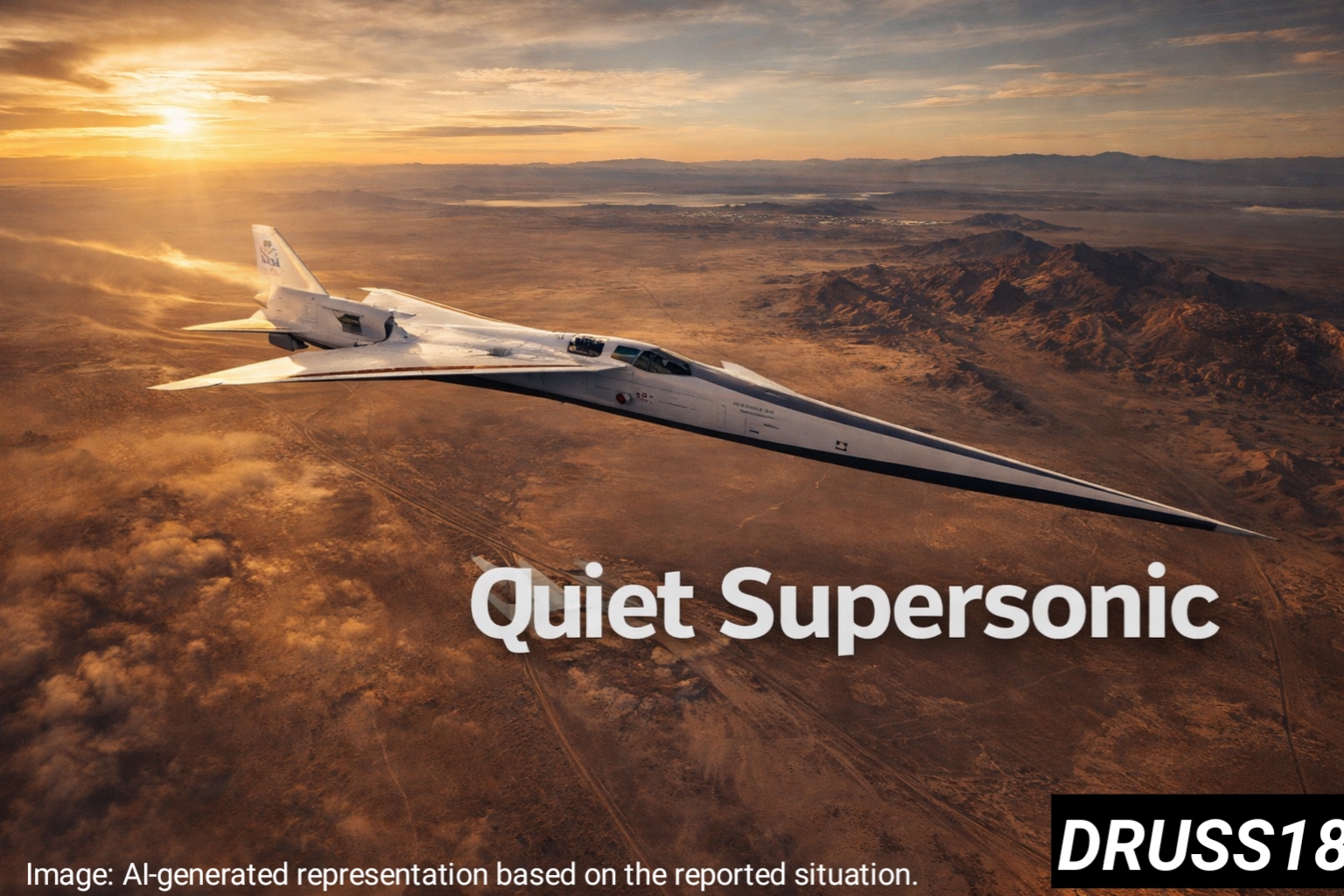
At first glance, the X-59’s unusually long, narrow nose stands out. But that design is not aesthetic—it is central to the aircraft’s mission.
Traditional supersonic jets create shockwaves that merge into a loud sonic boom. In contrast, the X-59 is engineered to reshape those shockwaves into a softer “thump.” According to NASA’s Quesst (Quiet Supersonic Technology) program, this is achieved through careful shaping of the fuselage and nose to control how pressure waves form and travel.
Instead of a sudden explosive sound, the goal is a quieter noise level of around 75 perceived decibels on the ground—closer to the sound of a car door closing than a thunderclap.
Built Through Industry Collaboration
The X-59 is not just a NASA project—it is the result of collaboration with major aerospace partners.
The aircraft has been developed by Lockheed Martin under NASA’s supervision. As outlined in Lockheed Martin’s Skunk Works technical briefings, the jet integrates advanced materials, precision manufacturing, and experimental flight systems to meet strict aerodynamic targets.
In addition, regulatory collaboration plays a key role. The Federal Aviation Administration has long enforced restrictions on supersonic flight over land due to noise concerns. Data from the X-59 program is expected to inform future policy decisions on whether those restrictions can be updated.
Why This Flight Matters
The third flight is significant not because of its duration, but because of what it represents: consistency.
Each successful flight allows engineers to refine data on:
Stability and control at subsonic and supersonic speeds
Aircraft handling and pilot response
Noise profile and shockwave behavior
According to NASA’s flight testing roadmap, repeated flights are essential before moving to the next phase—community overflight tests. In those future tests, the aircraft will fly over populated areas, and residents will be asked to report what they hear.
This real-world feedback will be critical in determining whether quiet supersonic travel is socially acceptable.
A Long Road from Concorde
Supersonic passenger travel is not new. The Concorde, operated until 2003, proved that faster-than-sound travel was technically possible.
However, its loud sonic booms and high operating costs limited its use to transoceanic routes.
The X-59 aims to solve one of those problems—noise.
By reducing the sonic boom, NASA hopes to open the possibility of overland supersonic travel, potentially cutting flight times dramatically. A journey that currently takes five hours could, in theory, be reduced to three or less.
What Comes Next for the X-59 Program
With multiple test flights now completed, the next phase of the NASA X-59 program will focus on validating its “low-boom” signature in real-world environments.
According to NASA’s Quesst mission outline, the aircraft will conduct flights over select U.S. communities, gathering public response data. This information will then be shared with regulators like the FAA and international aviation bodies.
The goal is not immediate commercialization, but something more foundational: changing the rules.
If regulators are convinced that quieter supersonic flight is viable, it could pave the way for a new generation of commercial aircraft developed by private companies.
A Turning Point for Aviation?
The NASA X-59 third flight may appear routine, but it reflects a deeper shift in aviation priorities.
Instead of focusing solely on speed, the emphasis is now on balancing performance with environmental and societal impact.
Will passengers one day fly from New York to Los Angeles in half the time—without hearing a thunderous boom below?
That question is no longer theoretical. With each flight, the answer is being tested in the skies above California.
Sources & Credits:
NASA – X-59 Quesst Mission Overview and Flight Updates
NASA Armstrong Flight Research Center – Flight Test Reports
Lockheed Martin Skunk Works – X-59 Development Briefings
Federal Aviation Administration (FAA) – Supersonic Flight Regulations
NASA Aeronautics Research Mission Directorate