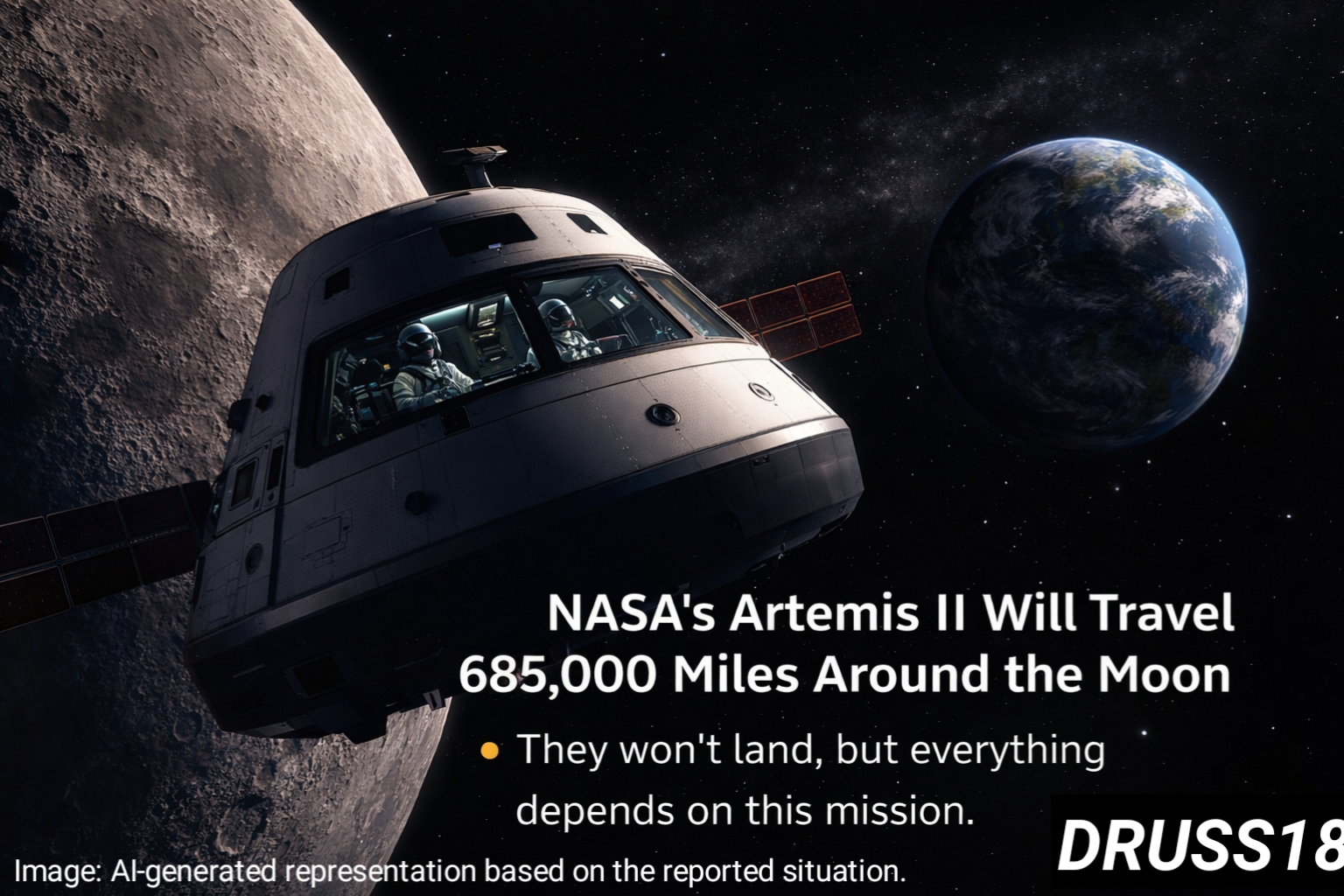
- NASA’s Artemis II Will Travel 685,000 Miles Around the Moon A new chapter in human spaceflight is about to unfold. NASA’s Artemis II mission will send astronauts around the Moon and back. But this journey is more complex—and more important—than it first appears.
A Journey That Looks Simple—But Isn’t
At first glance, it sounds straightforward: circle the Moon and return home. But the reality behind the NASA Artemis II Moon mission is far more complex.
The mission will send four astronauts on a journey of roughly 685,000 miles, looping around the Moon before heading back to Earth. Unlike the historic Apollo missions, Artemis II won’t land on the lunar surface.
That might seem like a step back. In reality, it’s a critical step forward.
According to NASA, this mission is designed to test every system needed for deep space travel—with humans on board—for the first time in over 50 years.
Why This Mission Matters More Than It Seems
This isn’t just another spaceflight. It’s a full systems test in deep space.
The spacecraft—Orion spacecraft—will operate far beyond Earth’s orbit. It will face extreme temperatures, radiation, and communication delays.
Data from NASA suggests that even small errors during this phase could affect future Moon landings. That’s why Artemis II is focused on safety, navigation, and real-world performance.
As reported by Reuters, this mission is a bridge between testing and actual lunar landing missions.
A Turning Point for Human Space Exploration
The Artemis program is not just about returning to the Moon. It’s about staying there—and going beyond.
Unlike the Apollo era, Artemis aims to build a long-term human presence on the Moon. This includes future bases, research stations, and even preparation for missions to Mars.
According to NASA, Artemis II will validate life-support systems, navigation paths, and crew operations in deep space. These are essential for upcoming missions like Artemis III, which aims to land astronauts on the lunar surface.
This mission also signals growing international collaboration, with agencies like the European Space Agency contributing key technologies.
What It Means for Life on Earth
It’s easy to think of space missions as distant and abstract. But their impact often reaches everyday life.
Technologies developed for deep space—like advanced materials, communication systems, and AI-driven navigation—often find their way into industries on Earth.
From medical imaging to satellite-based internet, past space programs have already shaped modern life. Artemis could push that even further.
There’s also a growing “space economy,” where private companies and governments invest in lunar exploration, resources, and infrastructure.
👉 This isn’t just about astronauts.
👉 It’s about the future of technology, business, and global collaboration.
The Challenges Still Ahead
Despite the excitement, Artemis II comes with real risks.
Deep space radiation remains a concern. Long-duration human spaceflight still presents unknowns. And every system—from propulsion to re-entry—must perform perfectly.
According to NASA, this mission is designed to uncover those risks before humans attempt to land on the Moon again.
In other words, it’s a test where failure is not the goal—but learning is essential.
What Comes Next After Artemis II
If Artemis II succeeds, the next step is clear: landing humans on the Moon again.
Artemis III aims to take astronauts to the lunar surface, potentially including the first woman and the first person of color to walk on the Moon.
Beyond that, NASA’s long-term vision includes building a sustainable lunar presence—and eventually sending humans to Mars.
But none of that happens without Artemis II.
Conclusion
The Artemis II mission may not include a Moon landing, but it represents something just as important: preparation.
What we know is clear—it’s a critical test of humanity’s ability to travel deeper into space. What remains uncertain are the challenges of long-term exploration. What comes next depends entirely on what we learn from this mission.
And for the first time in decades, humans are about to travel farther from Earth than ever before.
✅ Source Line
This article is based on publicly available data, official updates, and verified reports from NASA, Reuters, and other trusted scientific sources.