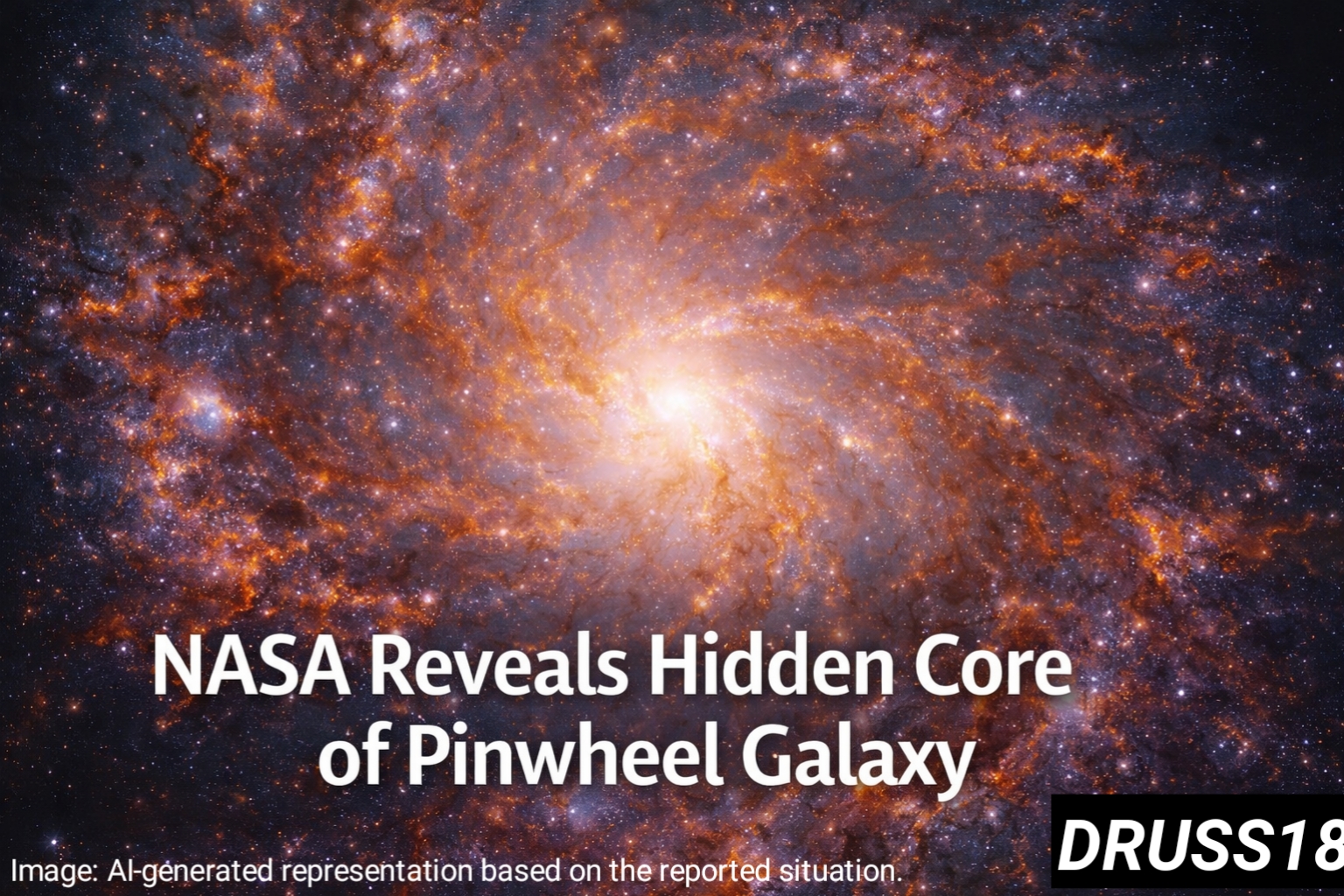
NASA Combines Hubble and Webb to Reveal a Pinwheel Galaxy core
A familiar galaxy has revealed something new.
NASA combined two powerful space telescopes to uncover hidden details.
The result could reshape how we understand star formation in galaxies.
A Familiar Galaxy—Seen in a Completely New Way
For decades, astronomers believed they had a clear picture of the Pinwheel Galaxy. But when NASA combined data from two of its most advanced observatories, something unexpected emerged.
The galaxy didn’t look the same anymore.
Instead of a smooth spiral structure, the core appeared far more complex—filled with tangled dust lanes, glowing gas, and clusters of newborn stars. What was once a familiar cosmic object suddenly became a fresh scientific puzzle.
Within the first look itself, one thing was clear: this was not just a prettier image—it was a deeper one.
How Two Space Telescopes Unlocked Hidden Details
The breakthrough comes from combining observations from the Hubble Space Telescope and the James Webb Space Telescope.
Each telescope sees the universe differently.
Hubble captures visible light, showing stars and bright regions
Webb detects infrared light, revealing dust and hidden structures
When these datasets were merged, astronomers could see both the stars and the material between them. According to NASA, this multi-wavelength approach allows scientists to trace how stars form inside dense clouds of gas and dust—regions that were previously invisible.
The orange filaments in the image represent warm dust glowing in infrared, while the blue-white areas highlight active star-forming regions.
This layered view is what makes the image scientifically powerful.
Why This Image Matters More Than It Looks
At first glance, it may look like just another beautiful space photo. But it carries deeper implications.
Understanding the Pinwheel Galaxy core helps scientists answer a much bigger question: How do galaxies grow and evolve over time?
Data from NASA suggests that star formation in spiral galaxies is not evenly distributed. Instead, it happens in chaotic, clustered regions influenced by gas density, gravity, and turbulence.
This insight can also be applied to our own galaxy, the Milky Way.
As reported in multiple scientific briefings, studying nearby galaxies like Messier 101 provides a “laboratory” for understanding processes happening across the universe.
The Human Angle: Why It Matters to Us
This kind of research is not just about distant galaxies.
It feeds directly into technologies we use on Earth.
Advances in imaging, data processing, and infrared detection—developed for missions like Webb—often lead to improvements in:
Medical imaging
Satellite communications
Climate monitoring systems
In simple terms, looking deeper into space helps improve life back home.
And beyond technology, there is something more fundamental: perspective.
Images like this remind us how small—and how connected—we are in a vast universe.
A Glimpse Into the Future of Space Observation
This combined image is also a preview of what future astronomy will look like.
Instead of relying on a single telescope, scientists are increasingly combining data from multiple observatories to build more complete pictures of the cosmos.
According to NASA, this approach will be essential for upcoming missions focused on dark matter, galaxy evolution, and potentially habitable worlds.
However, limitations remain.
Even with advanced instruments, many processes inside galaxies are still not fully understood. Dust can obscure signals, and interpreting multi-wavelength data requires complex modeling.
In other words, this discovery answers some questions—but raises many more.
Conclusion: A Deeper Look, A Bigger Mystery
The new view of the Pinwheel Galaxy core shows how much we still have to learn.
What we know: combining telescopes reveals hidden structures and new insights.
What’s uncertain: the exact mechanisms driving star formation in such regions.
What’s next: more combined observations, deeper analysis, and future missions.
And perhaps the most powerful takeaway is simple:
“The universe looks different when you learn how to see it differently.”
- This article is based on publicly available data, official updates, and verified reports from SpaceX, NASA, and other trusted scientific sources. 🚀