- Category: Science / Space
- Author: Druss18 Team
- Date: April 29, 2026
Summary:
- SpaceX is preparing to launch the final Viasat ViaSat-3 satellite aboard its heavy-lift Falcon Heavy rocket from Florida, marking the vehicle’s first mission in 18 months. The launch could complete a major global broadband constellation aimed at expanding high-capacity internet coverage across the Asia-Pacific region.
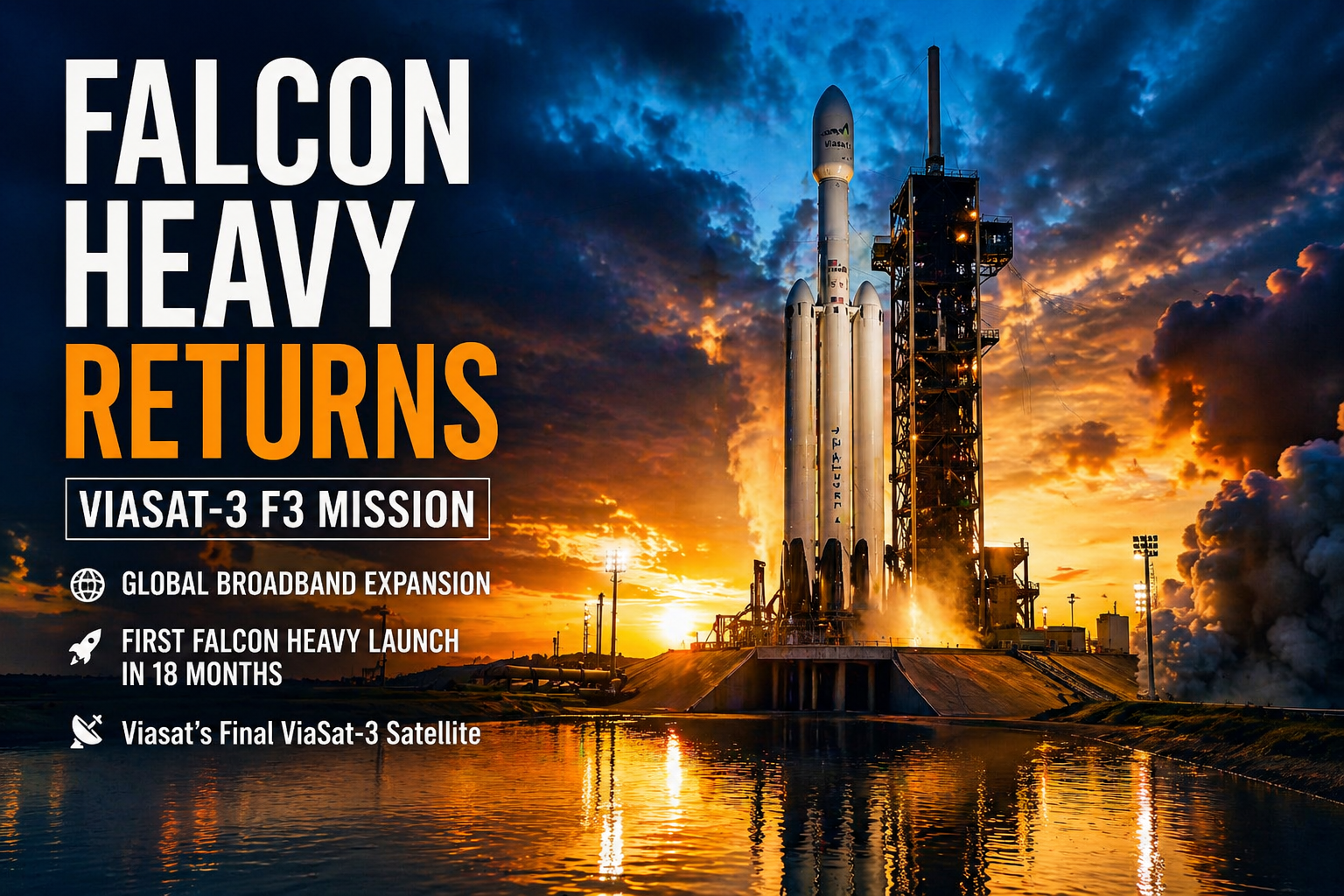
SpaceX Falcon Heavy ViaSat-3 launch For SpaceX, every launch carries technical significance. But the SpaceX Falcon Heavy ViaSat-3 F3 launch scheduled this week carries something broader: the completion of a satellite system designed to reshape global connectivity.
The mission, now targeting April 29 following a weather-related delay, will send Viasat’s third and final ViaSat-3 spacecraft into geostationary transfer orbit from NASA’s Kennedy Space Center in Florida. According to SpaceX’s official mission update, the launch window opens at 10:13 a.m. Eastern Time, with an 85-minute operational window.
That timing matters.
This will be Falcon Heavy’s first flight since its October 2024 mission carrying NASA’s Europa Clipper, ending an 18-month pause for one of the world’s most powerful operational rockets.
Why the ViaSat-3 F3 mission matters
The ViaSat-3 constellation is not just another communications project.
Each satellite is built for regional broadband dominance, together forming a network designed to provide ultra-high-capacity internet coverage worldwide. According to Viasat’s corporate mission briefing, the F3 satellite will focus on the Asia-Pacific region, completing the company’s three-satellite architecture.
That has implications far beyond consumer internet.
Satellite broadband increasingly supports aviation, maritime logistics, disaster recovery systems, and military communications. In remote regions where terrestrial fiber infrastructure remains limited, space-based internet can become the primary digital backbone.
And in Asia-Pacific — one of the fastest-growing digital markets — demand is rising sharply.
Falcon Heavy returns to active duty
The SpaceX Falcon Heavy ViaSat-3 F3 launch also puts focus back on Falcon Heavy itself.
Falcon Heavy generates roughly 5.1 million pounds of thrust at liftoff, according to SpaceX mission specifications, making it the second-most-powerful active rocket behind NASA’s Space Launch System.
Its architecture is unusual: three Falcon 9-derived boosters strapped together, powered by 27 Merlin engines.
That design allows Falcon Heavy to carry heavier payloads into high-energy orbits—something standard Falcon 9 missions cannot always do efficiently.
For ViaSat-3 F3, that capability is critical.
The satellite weighs approximately 6.6 metric tons and must reach geostationary transfer orbit before using onboard electric propulsion to gradually climb into its final orbital slot.
Think of it like getting dropped near your destination rather than at the exact address—the satellite still has work to do after launch.
Weather remains a persistent challenge
Rocket launches are often delayed for reasons unrelated to the rocket itself.
Earlier launch attempts were scrubbed because of poor weather conditions over Florida’s Space Coast, according to launch tracking reports and SpaceX mission updates.
Weather constraints affect not just launch safety but also booster recovery.
SpaceX plans to recover the side boosters at Cape Canaveral after separation, while the central core will be expended in the Atlantic Ocean—a mission profile chosen to maximize payload performance.
That tradeoff highlights a larger engineering question: how much reusability can be preserved while maintaining high-payload efficiency?
It’s a question SpaceX continues to refine.
The broader race for orbital internet
Viasat’s strategy differs from systems like SpaceX’s Starlink.
Where Starlink uses thousands of low-Earth orbit satellites, ViaSat focuses on fewer but extremely high-capacity geostationary spacecraft.
Both models solve the same problem differently.
Low-Earth orbit offers lower latency.
Geostationary orbit offers wider regional coverage with fewer satellites.
As governments and telecom providers push for universal connectivity, both architectures may end up coexisting rather than competing directly.
That matters for the future of digital infrastructure.
Because in the next decade, internet access may depend as much on orbital mechanics as undersea cables.
And if this launch succeeds, the SpaceX Falcon Heavy ViaSat-3 F3 launch could mark more than just another mission—it could signal the final piece of a global communications system entering operational reality.
The bigger question now is what comes next: faster networks, broader coverage, or entirely new orbital business models.
Space infrastructure is no longer experimental.
It is becoming essential.
Sources & Credits:
SpaceX Official Mission Update
Viasat Corporate Launch Briefing
NASA Kennedy Space Center Launch Operations
Spaceflight Now Launch Coverage