- Category: Science / Space
- Author: Druss18 Team
- Date: May 21, 2026
Summary:
Keyword: Starship V3 Launch SpaceX has fully stacked its Starship V3 vehicle at the Starbase launch site in Texas ahead of the company’s expected Flight 12 mission. The latest update signals that final preparations are underway as SpaceX pushes forward with the next phase of its reusable heavy-lift rocket program.
SpaceX’s next Starship mission appears to be entering its final preparation phase.
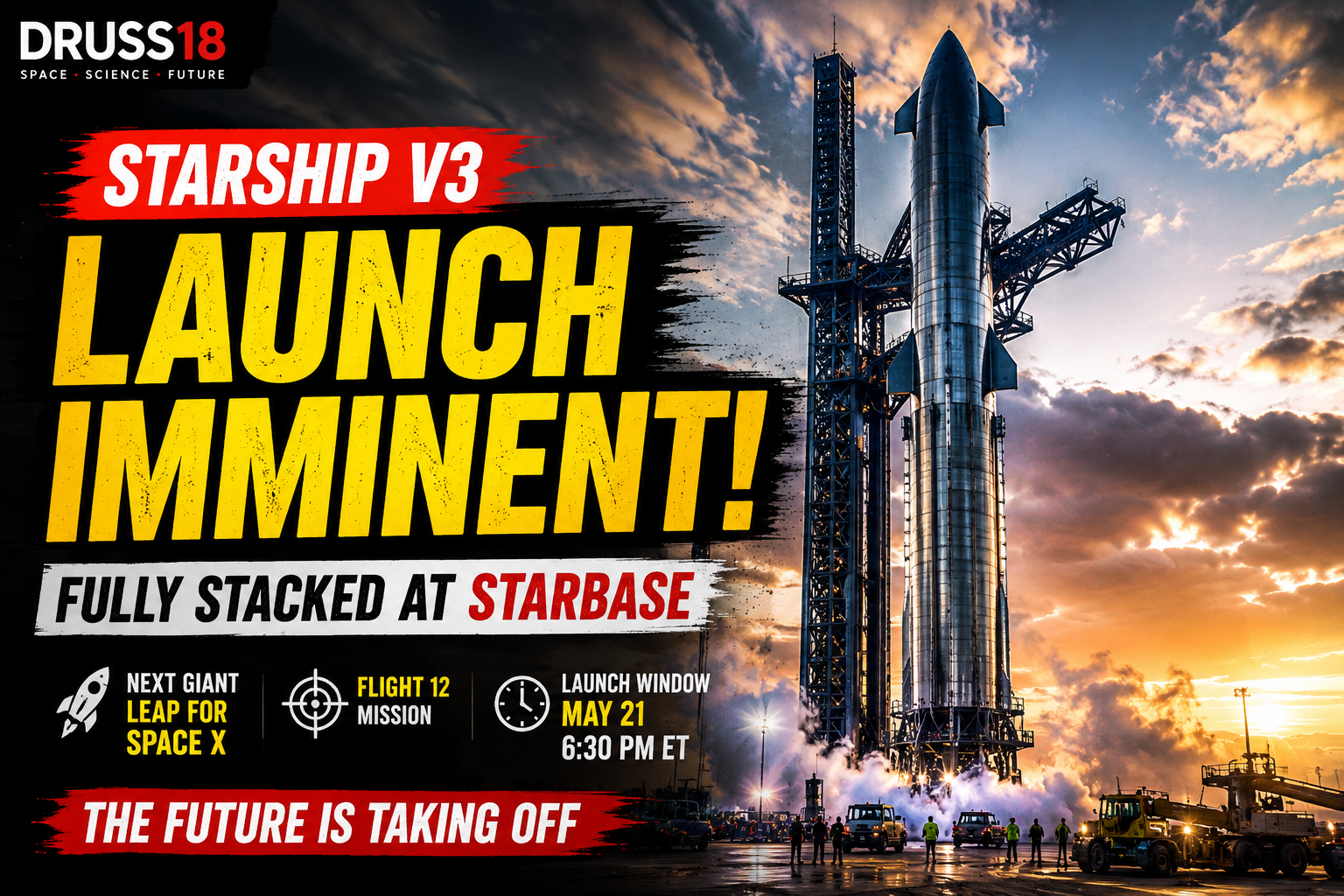
In a post shared on X, the company confirmed that the Starship V3 vehicle has been fully stacked on the launch pad at Starbase, Texas. The update quickly drew widespread attention online as anticipation builds around what could become one of the most closely watched Starship test flights to date.
The stacked vehicle includes the latest version of the Super Heavy booster alongside the upgraded Starship upper stage. According to SpaceX, the integrated system is now undergoing final checks ahead of the planned Flight 12 launch attempt.
Why the Starship V3 Test Matters
The Starship V3 configuration represents one of the most heavily revised versions of the spacecraft since SpaceX began integrated flight tests in 2023.
While the company has not publicly detailed every engineering modification, recent updates suggest improvements involving thermal protection systems, engine reliability, flight control software, and booster recovery hardware. SpaceX has consistently used rapid testing cycles to refine the Starship platform after each launch campaign.
According to NASA, Starship remains a critical component of the Artemis program, which aims to return astronauts to the Moon later this decade. NASA previously selected a lunar-adapted version of Starship as the Human Landing System for Artemis III.
That partnership means ongoing Starship tests are no longer viewed solely as commercial demonstrations. The vehicle’s performance could directly influence future lunar mission timelines and long-term deep-space transportation plans.
Starbase Becomes the Center of SpaceX Operations
The Starbase facility in South Texas has evolved rapidly over the last several years into one of the world’s most active private launch development sites.
Towering launch infrastructure, engine test facilities, and booster integration systems now dominate the coastal landscape near Boca Chica. The latest stacking operation once again highlighted the scale of the Starship system, which remains the largest rocket ever constructed.
FAA licensing records and environmental reviews show that SpaceX continues expanding launch and testing operations at the site while working through regulatory requirements tied to launch frequency and public safety.
Unlike traditional aerospace programs that often move through long development cycles, SpaceX relies on repeated flight testing and iterative engineering updates. That strategy has produced both rapid advancements and highly public technical setbacks during previous Starship missions.
Flight 12 Could Provide Critical Data
The upcoming Flight 12 mission is expected to focus on several key objectives.
Engine performance during ascent, stage separation reliability, orbital trajectory control, and atmospheric reentry systems are all likely areas of close monitoring. Recovery operations for the Super Heavy booster may also play a major role in evaluating progress toward full reusability.
SpaceX founder Elon Musk has repeatedly emphasized that Starship is intended to become a fully reusable transportation platform capable of supporting missions beyond Earth orbit, including eventual crewed missions to Mars.
At the same time, aerospace analysts note that major technical hurdles still remain before Starship can support routine operational missions. Heat shield durability, propellant transfer systems, and rapid launch turnaround capabilities continue to be central engineering challenges.
Public Interest Around Starship Continues Expanding
Few modern aerospace programs attract as much online attention as Starship.
Images of the stacked vehicle at Starbase spread rapidly across X and other social platforms following SpaceX’s update, reflecting growing public fascination with large-scale reusable launch systems. The visual scale of Starship, combined with the long-term possibility of lunar and Mars missions, has helped transform routine development milestones into major internet events.
Yet the broader significance extends beyond social media visibility.
According to NASA and the FAA, next-generation reusable launch systems could reshape both government and commercial access to space over the coming decade. Lower launch costs and increased mission frequency may eventually influence satellite deployment, lunar logistics, scientific research, and international competition in space exploration.
For now, attention remains focused on South Texas as SpaceX prepares for another high-profile launch attempt. Whether Flight 12 proceeds smoothly or encounters new technical challenges, the mission will likely provide valuable data that shapes the future direction of the Starship program.
And as testing accelerates, the project is increasingly becoming more than a private aerospace initiative — it is emerging as a major indicator of how rapidly human spaceflight technology may evolve in the years ahead.
Sources & Credits:
SpaceX Official Website
NASA Artemis Program
Federal Aviation Administration – Commercial Space Transportation
SpaceX Updates on X