- Category: Science / Space
- Author: Druss18 Team
- Date: April 11, 2026
Summary:
The Artemis II mission has concluded with a successful splashdown, bringing astronauts safely back to Earth after a 10-day journey around the Moon. The mission marks a crucial step in NASA’s long-term lunar exploration plans.
Artemis II Splashdown Completes Historic Lunar Test Mission
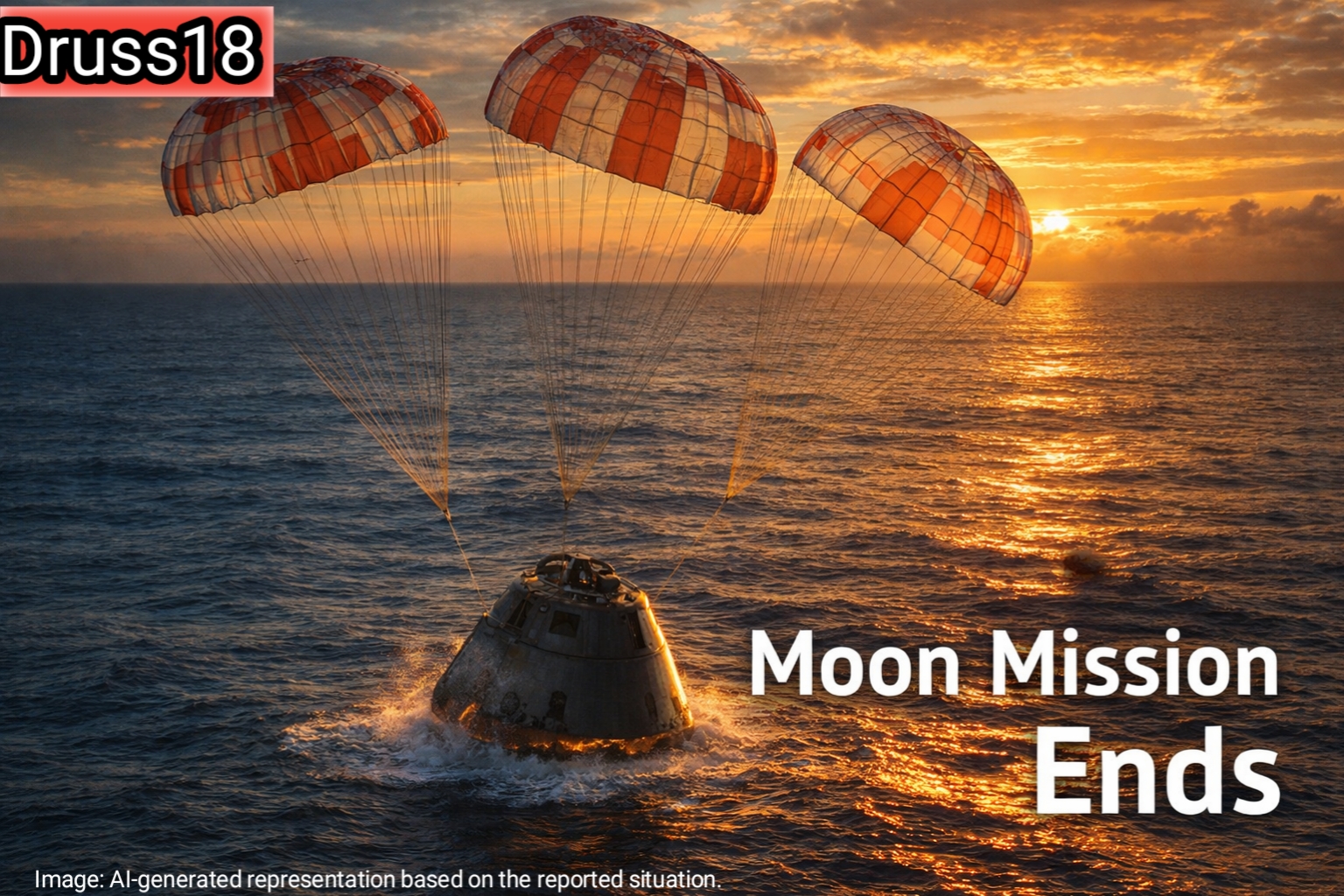
The Artemis II splashdown has officially marked the end of a critical chapter in modern space exploration, as astronauts returned safely to Earth following a 10-day mission around the Moon.
According to NASA, the crew capsule splashed down at approximately 8:07 p.m. Eastern Time, concluding a mission designed to test deep-space human travel systems for the first time in decades.
This mission is widely seen as a bridge between past lunar exploration efforts and future human landings under the Artemis program.
A Crewed Return to Deep Space
Artemis II carried four astronauts on a journey beyond low Earth orbit, circling the Moon before heading back home. Unlike the uncrewed Artemis I mission, this flight placed humans aboard the Orion spacecraft, testing life-support systems, navigation, and re-entry procedures under real conditions.
NASA confirmed that all major systems performed as expected. The mission also validated the spacecraft’s heat shield during high-speed re-entry—one of the most dangerous phases of deep-space missions.
Data released by NASA indicates that the capsule endured temperatures exceeding 2,700°C during atmospheric re-entry, a critical benchmark for future missions.
Why the Artemis II Splashdown Matters
The successful Artemis II splashdown is not just a mission milestone—it is a systems validation step for upcoming lunar landings.
As outlined in NASA’s Artemis campaign plans, Artemis II is a precursor to Artemis III, which aims to land humans near the Moon’s south pole. This region is of particular interest due to the presence of water ice, as confirmed by observations from the European Space Agency and NASA’s Lunar Reconnaissance Orbiter.
The ability to safely send astronauts around the Moon—and bring them back—is essential before attempting a landing mission.
Engineering, Safety, and Global Collaboration
The mission also reflects years of collaboration between government agencies and private contractors. The Orion spacecraft was developed in partnership with Lockheed Martin, while the Space Launch System (SLS) rocket was built with contributions from multiple international partners.
According to Lockheed Martin’s technical briefings, the Orion capsule includes advanced avionics, radiation protection, and automated navigation systems designed for deep-space operations.
Meanwhile, recovery operations were conducted in coordination with the U.S. Navy, ensuring safe retrieval of both crew and spacecraft.
From Apollo to Artemis: A New Era Begins
It has been more than five decades since humans last traveled beyond low Earth orbit during the Apollo 17 mission. Artemis II represents the first crewed mission to venture that far since then.
However, today’s mission goals are broader. Instead of short-term exploration, Artemis is designed for sustained human presence on the Moon and eventual missions to Mars.
NASA officials have emphasized that Artemis missions will test technologies needed for long-duration spaceflight, including habitat systems, resource utilization, and deep-space communication.
What Comes Next After Artemis II
With Artemis II successfully completed, attention now turns to Artemis III. This upcoming mission aims to achieve the first human landing on the Moon since 1972, potentially within this decade.
Still, challenges remain. Engineers must refine landing systems, ensure astronaut safety, and address the complexities of operating in the Moon’s harsh environment.
As NASA continues to analyze data from Artemis II, the focus will be on improving mission reliability and preparing for longer-duration stays on the lunar surface.
A Measured Step Toward the Future
The Artemis II splashdown may appear as a routine return, but it represents something far more significant: a tested pathway back to deep space.
For scientists, engineers, and policymakers, the mission offers valuable insights into how humans can safely travel beyond Earth’s orbit again. For the public, it signals that lunar exploration is no longer a distant ambition—but an active, evolving reality.
And as the Artemis program progresses, one question quietly emerges: how soon will humans not just visit the Moon—but stay?
Sources & Credits:
NASA (Artemis II mission updates and official statements)
European Space Agency (Lunar observations and collaboration data)
Lockheed Martin (Orion spacecraft technical briefings)
NASA Lunar Reconnaissance Orbiter mission data