- Category: Science / Space
- Author: Druss18 Team
- Date: April 20, 2026
Summary:
A recent static fire test of SpaceX’s Starship Super Heavy V3 has captured over 21 million views online, signaling growing global interest in next-generation launch systems. The 33-engine test marks a key milestone in heavy-lift rocket development.
A High-Profile Test Captures Global Attention
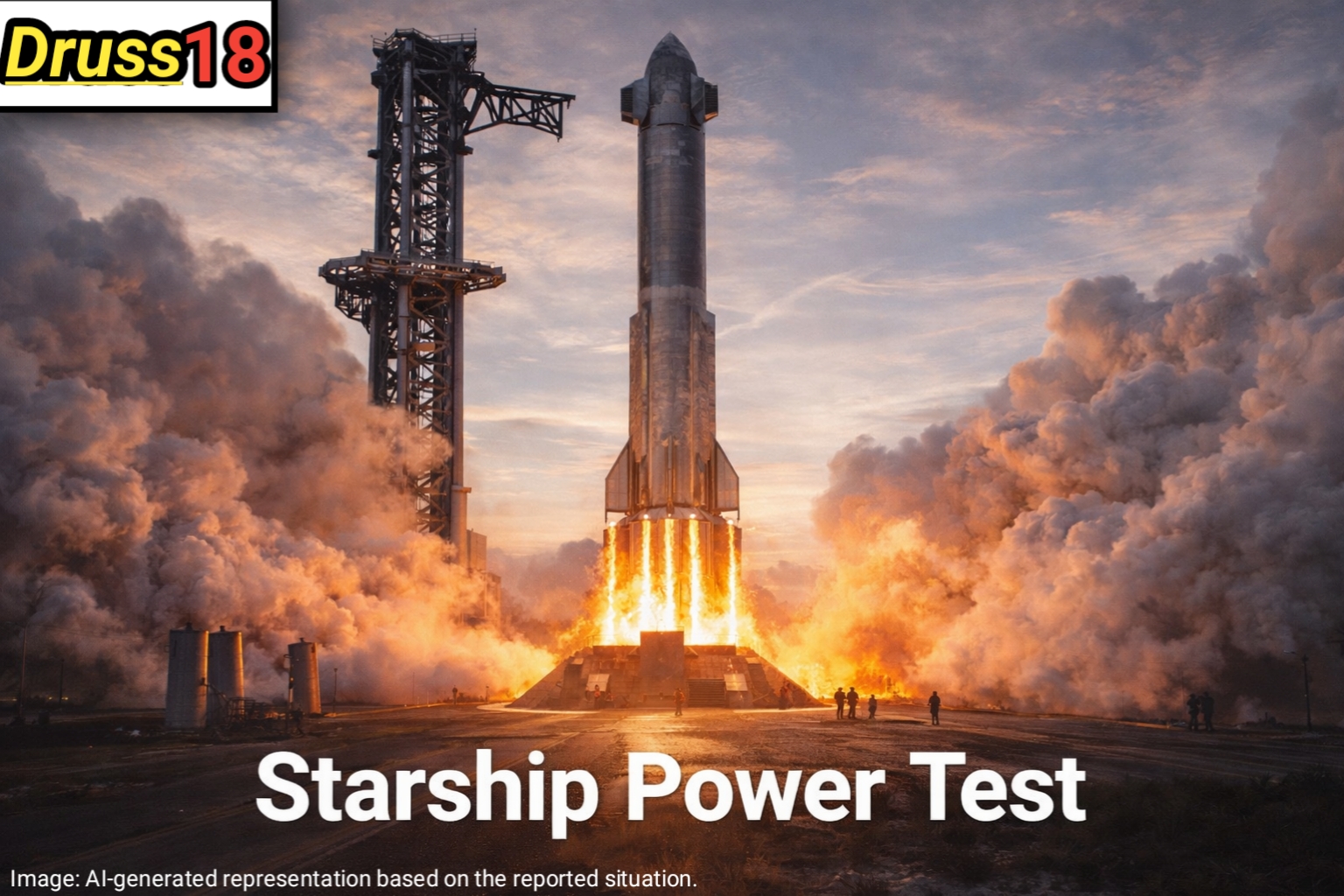
The latest SpaceX Starship Super Heavy V3 static fire has quickly become one of the most-watched spaceflight events online, surpassing 21 million views across platforms. The test, conducted at SpaceX’s Starbase facility in Texas, involved igniting all 33 Raptor engines on the Super Heavy booster while the rocket remained anchored to the launch mount.
This type of test—known as a static fire—is a critical step before any orbital launch attempt. It allows engineers to verify engine performance, structural integrity, and ground systems under real conditions without committing to liftoff.
According to official updates shared by SpaceX, this marks the first successful full-duration static fire for the V3 configuration of the Super Heavy booster, a version expected to play a central role in upcoming Starship missions.
Why the Starship Super Heavy V3 Matters
The Starship Super Heavy V3 static fire represents more than just a technical test—it reflects the rapid evolution of heavy-lift launch systems.
The Super Heavy booster is designed to be the most powerful rocket stage ever built. With 33 methane-fueled Raptor engines, it generates significantly more thrust than NASA’s historic Saturn V rocket. According to data released by NASA, the Saturn V produced about 35 MN of thrust at liftoff, while Super Heavy is expected to exceed that figure by a considerable margin.
This increase in power is essential for SpaceX’s long-term ambitions, which include:
Lunar missions under NASA’s Artemis program
Cargo and crew transport to Mars
Deployment of large satellite constellations like Starlink
The V3 iteration is believed to include refinements in engine reliability, thrust vector control, and booster recovery systems, although detailed specifications are still being gradually disclosed.
Engineering Challenges Behind 33 Engines
Managing 33 engines simultaneously is not a trivial task. Each Raptor engine must ignite in a carefully controlled sequence, maintain stable combustion, and respond to real-time adjustments.
According to technical discussions published by Federal Aviation Administration filings, large-scale rocket systems like Starship require extensive ground testing to validate safety margins before flight approval.
Even minor instability in one engine can affect the entire system. That is why static fire tests are repeated multiple times before launch clearance is granted.
The recent test suggests improved synchronization and control compared to earlier prototypes, which experienced issues such as engine shutdowns and uneven thrust distribution.
Public Interest Signals a Shift in Space Engagement
The 21 million views generated by the SpaceX Starship Super Heavy V3 static fire highlight a broader trend: spaceflight is no longer a niche interest.
Live streams and social media clips are bringing rocket science into mainstream attention. Events that were once followed only by specialists are now watched globally in real time.
This growing visibility has implications beyond entertainment. Increased public engagement can influence funding decisions, policy discussions, and international collaboration in space exploration.
As noted in recent outreach data from European Space Agency, digital engagement plays an increasing role in shaping public perception of space programs and their value.
What Comes Next for Starship
While the static fire is a major milestone, several steps remain before the next orbital flight. These include:
Final system inspections
Regulatory approvals
Additional ground tests if required
SpaceX has not announced an exact launch date, but the successful test indicates that preparations are moving forward steadily.
Looking ahead, the performance of the V3 booster will be closely watched. If it delivers consistent reliability, it could accelerate timelines for both lunar and deep-space missions.
A Broader Turning Point in Launch Systems
The SpaceX Starship Super Heavy V3 static fire is not just a technical checkpoint—it reflects a shift in how space infrastructure is being built.
Reusable, high-capacity rockets could reduce launch costs and enable more frequent missions. This, in turn, may reshape everything from satellite deployment to human space exploration.
Yet uncertainties remain. Questions around long-term reliability, environmental impact, and regulatory frameworks are still being addressed.
What is clear, however, is that each successful test brings the industry closer to a new era—one where large-scale space travel becomes more routine rather than exceptional.
Sources & Credits:
SpaceX official updates and mission briefings
NASA Artemis and heavy-lift rocket data
Federal Aviation Administration (FAA) launch regulations and filings
European Space Agency (ESA) public engagement reports