- Category: Science / Space
- Author: Druss18 Team
- Date: April 15, 2026
Summary:
SpaceX has completed a full-duration static fire test of its Starship V3 prototype, signaling progress in its next-generation launch system. The test offers insight into engine performance, safety, and readiness for future orbital missions.
A Critical Test for Starship V3 Static Fire
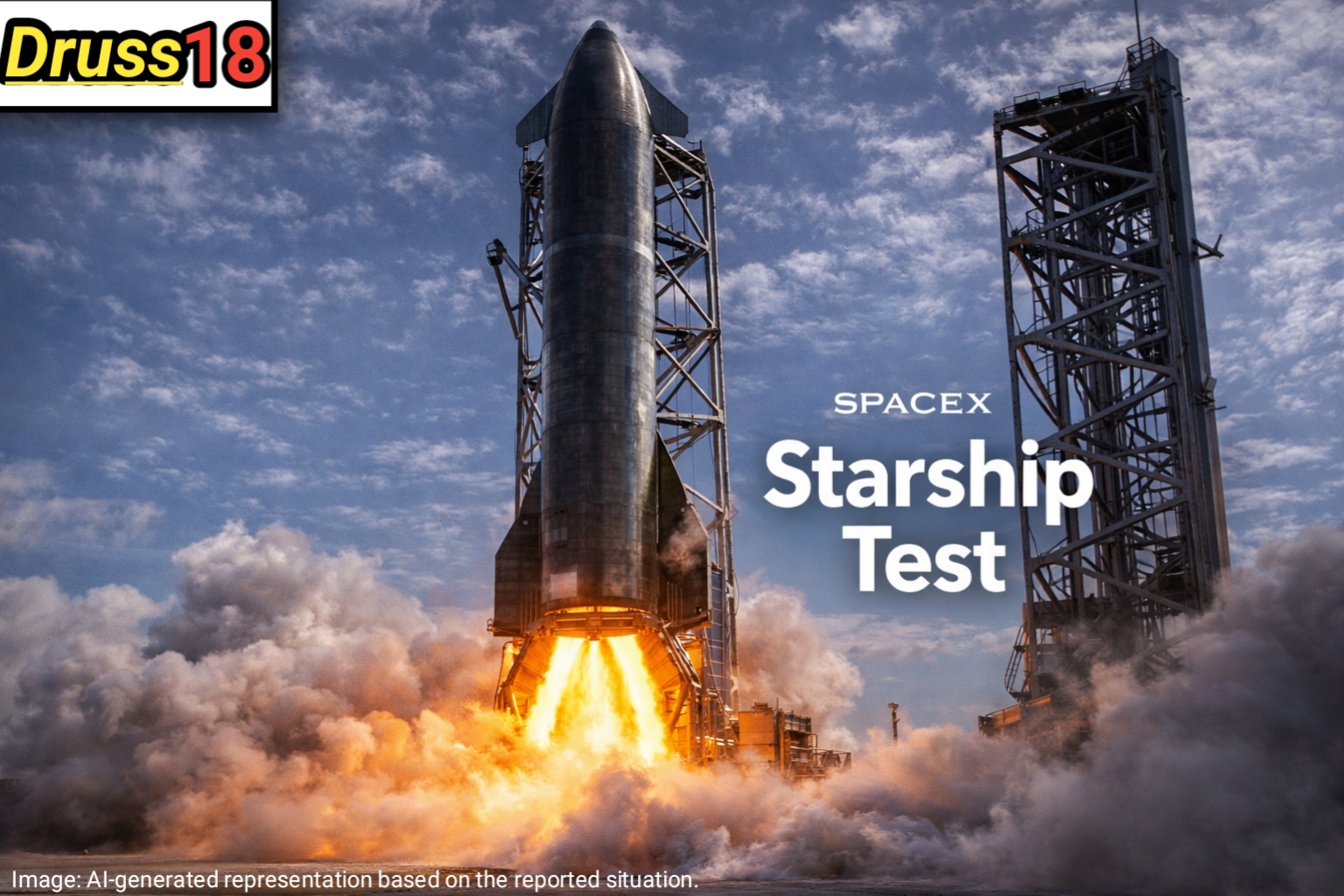
In a recent update, SpaceX confirmed a full-duration Starship V3 static fire, a test that simulates the rocket’s engines firing while the vehicle remains secured to the ground. This milestone, shared publicly through the company’s official channels, represents an important validation step for the upgraded Starship design.
Why does this matter now? Because the Starship program sits at the center of future plans for deep space missions, including lunar landings and potential Mars exploration.
What Is a Static Fire and Why It Matters
A static fire test allows engineers to evaluate engine performance, structural integrity, and fuel systems under controlled conditions. Unlike a launch, the rocket remains anchored, but its engines operate at near-flight conditions.
According to NASA, such ground-based tests are essential for identifying anomalies before flight, particularly in complex heavy-lift systems. For Starship V3, this full-duration firing suggests improved confidence in its Raptor engines and overall system stability.
This version of Starship is expected to incorporate iterative upgrades over earlier prototypes, focusing on durability, efficiency, and reusability.
How Starship V3 Differs from Earlier Versions
The Starship program has evolved rapidly through multiple prototypes, each contributing incremental improvements. Starship V3 appears to emphasize:
Enhanced engine reliability
Structural refinements for repeated use
Improved thermal protection systems
Data submitted to the Federal Aviation Administration during licensing processes has highlighted the increasing complexity of these systems, particularly as SpaceX prepares for more ambitious missions.
Earlier tests often faced challenges, including engine shutdowns and structural failures. A full-duration static fire indicates that at least some of those issues are being addressed systematically.
Broader Context: From Earth Orbit to Deep Space
The Starship system is not just another launch vehicle. It is designed as a fully reusable spacecraft capable of carrying both cargo and crew beyond Earth orbit.
NASA has already selected a variant of Starship for its Artemis lunar program, where it is expected to serve as a human landing system. This places additional pressure on SpaceX to demonstrate consistent reliability.
At the same time, industry observers note that regulatory oversight remains a key factor. The Federal Aviation Administration continues to review environmental and safety considerations for Starship launches, particularly at the company’s Texas test site.
What Comes Next After This Test
A successful static fire does not guarantee an immediate launch, but it significantly reduces uncertainty. Engineers will now analyze data from the test, focusing on engine thrust levels, fuel flow, and thermal behavior.
If results meet expectations, the next step could involve integrated flight testing, potentially leading to orbital attempts.
There are still open questions. How will Starship V3 perform under full flight conditions? Can it achieve rapid reusability at scale? And how quickly can SpaceX transition from testing to operational missions?
Looking Ahead
The Starship V3 static fire represents more than a routine test—it reflects the iterative nature of modern aerospace engineering. Each successful milestone narrows the gap between concept and capability.
As space agencies and private companies increasingly align their ambitions, systems like Starship may redefine how humanity approaches space travel. The pace of progress suggests that what once seemed distant—routine missions to the Moon or even Mars—may depend less on possibility and more on execution.
Sources & Credits:
SpaceX official updates and mission releases
NASA Artemis program and technical documentation
Federal Aviation Administration launch licensing and safety data
Public aerospace engineering research and industry reports